VnCommEx
Hợp tác xuất khẩu SUBSCRIBE
VnCommEx
Hợp tác xuất khẩu SUBSCRIBE
  • VCE
  • Product Catalogue
  • Market Insight
    • Wood & Furniture
    • Garment & Footwear
    • Food & Spicy Industry
    • Fruit & Vegetable
    • Others
    • Market Insights
  • Vietnam Market
    • Vietnam Commodity Market Price
    • Vietnam Export Data
    • Vietnam in FTA
  • Publication
  • About Us
  • English
    • 中文 (中国)
    • Tiếng Việt
VnCommEx
VnCommEx
  • VCE
  • Product Catalogue
  • Market Insight
    • Wood & Furniture
    • Garment & Footwear
    • Food & Spicy Industry
    • Fruit & Vegetable
    • Others
    • Market Insights
  • Vietnam Market
    • Vietnam Commodity Market Price
    • Vietnam Export Data
    • Vietnam in FTA
  • Publication
  • About Us
  • English
    • 中文 (中国)
    • Tiếng Việt
All Right Reserved. Designed and Developed by PenciDesign
Market Insights

Vietnam’s Exports Nearly USD 350 Billion in 9M/2025, Up 16% YoY

by Henry Truong October 8, 2025
written by Henry Truong

How did Vietnam’s exports perform in the first nine months of 2025?

In the first nine months of 2025, Vietnam’s exports showed a robust recovery, reaching a total merchandise export turnover of USD 348.74 billion, an impressive 16.0% year-on-year growth. This strong performance also resulted in a positive trade balance with a surplus of USD 16.82 billion, though a closer look reveals that this growth is largely driven by the FDI sector and high-tech products.

1.1. Overall Results (9M/2025)

Total merchandise export turnover in the first nine months of 2025 reached USD 348.74 billion, recording an impressive 16.0% year-on-year growth.

Notably, the trade balance continued to remain positive with a trade surplus of USD 16.82 billion.

1.2. Short-Term Dynamics (September 2025)

Export turnover in September 2025 reached USD 42.67 billion. However, the month-over-month (MoM) growth rate showed a slight slowdown:

  • Overall exports decreased 1.7% compared to August 2025.
  • Both key sectors recorded declines: the domestic economic sector down 5.5%, and the FDI sector down 0.6% month-over-month.

This mild contraction in September indicates that exports are facing external adjustment pressures — potentially due to rising logistics costs or order adjustments from major consumer markets.

1.3. The Dominant Role of the FDI Sector

Vietnam’s export growth and trade surplus are entirely driven by the foreign-invested (FDI) sector:

Indicator FDI Sector (incl. crude oil) Domestic Sector
Export Value (9M) USD 263.33 billion USD 85.41 billion
Export Share (9M) 75.50% 24.50%
YTD Growth (9M) 0.214 0.02
Trade Balance (9M) Surplus of USD 37.08 billion Deficit of USD 20.26 billion


What types of products does Vietnam export the most?

Vietnam’s export commodity structure in the first nine months of 2025 highlights a significant focus on manufactured industrial goods, particularly high-tech products. These processed industrial goods accounted for a substantial 88.6% of total export turnover, reaching USD 309.03 billion.

2.1. Processed Industrial Goods (88.6% Share)

Processed industrial products reached USD 309.03 billion, accounting for 88.6% of total export turnover.

Commodity Value (USD) Growth (%)
Computers, electronic products & components 77,485,468,217 45.90%
Phones & components 43,592,198,707 4.10%
Machinery, equipment, tools & spare parts 42,996,871,475 13.50%
Textiles & garments 29,743,843,452 8.60%
Footwear 17,792,211,976 7.40%
Other commodities 16,352,695,443 17.30%
Vehicles & parts 12,775,794,413 13.30%
Wood & wood products 12,496,573,339 6.80%
Aquatic products 8,169,380,026 13.00%
Coffee 7,010,973,110 62.20%
Toys, sports equipment & parts 6,549,296,307 134.60%
Fruits & vegetables 6,131,323,223 8.70%
Cameras, camcorders & components 5,862,649,805 -4.60%
Plastic products 5,495,473,366 13.00%
Iron & steel 5,173,919,242 -28.30%


High-Tech Highlight: Computers, electronic products, and components have solidified their No.1 position with a dominant turnover of over USD 77.48 billion and an extraordinary 45.9% YTD growth. Together with phones and machinery & equipment, these form a “pillar trio” that accounts for nearly half of total exports.

Traditional Sector Highlight: Traditional export sectors such as textiles (USD 29.74 billion) and footwear (USD 17.79 billion) remain vital but recorded more modest growth rates (+8.6% and +7.4% YTD, respectively). Some categories witnessed breakthrough growth, notably toys, sports equipment & parts with +134.6% YTD (USD 6.55 billion), reflecting a strong rebound in global consumer demand.

2.2. Agriculture, Forestry, and Fishery Products (11.4% Share)

Agricultural, forestry, and fishery products (including fuels and minerals) accounted for 11.4% of total exports.

  • Agricultural & forestry products: USD 29.51 billion (8.5% share).
  • Fishery products: USD 8.17 billion (2.3% share).
  • Fruits & vegetables: Remain a bright spot with USD 6.13 billion, up 8.7% YTD.

Which countries are Vietnam’s main export markets?

Vietnam’s export markets are primarily concentrated among key partners like the United States, China, and the European Union. This concentration, while driving significant trade volumes, also introduces potential geopolitical and trade risks due to heavy reliance on these major economies.

3.1. Key Export Markets

United States (US): Continues to be Vietnam’s largest export market, with a turnover of USD 112.8 billion in the first nine months. The U.S. mainly imports manufactured goods, textiles, footwear, and electronics. Vietnam’s trade surplus with the U.S. reached USD 99.1 billion.

China: Vietnam’s second-largest export market, but simultaneously its largest import source (USD 134.4 billion). As a result, Vietnam recorded its largest trade deficit of USD 84.8 billion with China.

European Union (EU): A strategic market boosted by the EVFTA. Exports to the EU have grown strongly, particularly in agricultural products.

What are the key challenges and future outlook for Vietnam’s exports?

While Vietnam’s exports achieved a solid 16.0% year-to-date growth in the first nine months of 2025, establishing a strong foundation, this stability is heavily reliant on two main pillars: the Foreign Direct Investment (FDI) sector and high-tech manufacturing. This dependency presents strategic challenges for sustainable growth.

However, this stability relies heavily on two pillars: the FDI sector and high-tech manufacturing.

Strategic Challenges

High Dependency: Heavy reliance on the FDI sector (75.5% of exports) and high-tech goods (nearly 50% of total export value) exposes Vietnam to concentration risks.
Any disruption in global supply chains or decline in tech demand could have significant impacts.

Weak Domestic Competitiveness: The domestic sector grew only 2.0% YTD and recorded a trade deficit of USD 20.26 billion, indicating that Vietnamese enterprises’ internal growth momentum remains weak and requires stronger policy and structural support.

See more: 
  • Vietnam Exports 8 Months 2025: High Technology Leads, Agricultural Products Make a Breakthrough
  • Vietnam’s agricultural processing industry on the way to development
October 8, 2025 0 comment
0 FacebookTwitterLinkedinWhatsapp
Free Trade Agreement

ASEAN – Korea Comprehensive Economic Cooperation Agreement

by Henry Truong October 8, 2025
written by Henry Truong

What is the ASEAN-Korea Free Trade Agreement (AKFTA)?

The ASEAN-Korea Free Trade Agreement (AKFTA), officially known as the Framework Agreement on Comprehensive Economic Cooperation between the Association of Southeast Asian Nations (ASEAN) and the Republic of Korea, is a comprehensive Free Trade Agreement (FTA). It comprises three main component agreements: the Agreement on Trade in Goods (TIG), the Agreement on Trade in Services, and the Agreement on Investment. This agreement involves all 10 ASEAN Member States (Brunei Darussalam, Cambodia, Indonesia, Lao PDR, Malaysia, Myanmar, the Philippines, Singapore, Thailand, and Viet Nam) and the Republic of Korea (ROK).

Dates of Signing and Entry into Force:

Agreement Date of Signing Date of Entry into Force
Framework Agreement on Comprehensive Economic Cooperation 13 December 2005 –
Agreement on Trade in Goods (TIG) 24 August 2006 1 June 2007
Agreement on Trade in Services 20 November 2007 1 May 2009
Agreement on Investment 2 June 2009 1 September 2009


Why was the AKFTA established?

The AKFTA was established to deepen economic ties between ASEAN and Korea, building on a dialogue partnership initiated in 1989 and elevated to a Summit level in 1997, recognizing Korea as a vital economic partner for ASEAN. The primary rationale for its formation was to establish the ASEAN–Korea Free Trade Area (AKFTA) within ten years, aiming to strengthen economic, trade, and investment cooperation. This involved liberalizing markets by removing most tariff and non-tariff barriers across goods, services, and investment, thereby facilitating mutual market access. Additionally, the agreement sought to integrate supply chains, linking ASEAN’s dynamic manufacturing capabilities with Korea’s industrial and technological strengths.

What are the key commitments and scope of the AKFTA?

AKFTA is a comprehensive agreement encompassing trade in goods, services, and investment, which are implemented through three separate agreements.

Main Chapters of the Agreement on Trade in Goods (TIG):

ChapterTitleKey Provisions
1General ProvisionsDefines the scope and objectives of the Agreement.
2Elimination of TariffsSets out the schedules and modalities for tariff reduction and elimination. Goods are categorized into: Normal Track (NT); Sensitive Track (ST); and Highly Sensitive List (HSL).
3Rules of Origin (ROO)Establishes origin criteria: a minimum Regional Value Content (RVC) of 40%; and/or Change in Tariff Heading (CTH) at the 4-digit HS level.
4Non-Tariff MeasuresAddresses non-tariff measures to ensure transparency and non-discrimination.
5Trade RemediesCovers trade defense instruments such as anti-dumping; countervailing; and global safeguard measures (including special safeguard provisions for ASEAN).
6Institutional MechanismEstablishes the Goods Trade Committee and working groups to oversee implementation of the Agreement.

Key Commitments:

  • Tariff Liberalisation: Viet Nam was granted a longer tariff reduction schedule (about six years) compared to the ASEAN-6 countries, aiming to eliminate tariffs on most items in the Normal Track by 2018.
  • Certificate of Origin (C/O): The AKFTA Certificate of Origin uses Form AK.

Where can I find official AKFTA reference materials and legal documents?

Official English versions of the full AKFTA text and its relevant agreements—the ASEAN–Korea Agreement on Trade in Goods, the ASEAN–Korea Agreement on Trade in Services, and the ASEAN–Korea Agreement on Investment—are available on the ASEAN Secretariat website (www.asean.org) and the website of the Ministry of Trade, Industry, and Energy of the Republic of Korea (MOTIE). For implementation guidelines specific to Vietnam, the Vietnam FTA Portal (Ministry of Industry and Trade) at https://vntr.moit.gov.vn/ offers summaries of commitments, tariff reduction schedules, and rules of origin. Additionally, Vietnamese legal documents such as Government Decrees on Vietnam’s Special Preferential Import Tariff Schedule and Circulars from the Ministry of Industry and Trade provide specific rules of origin under the AKFTA. Further guidance for enterprises and customs procedures for using C/O Form AK can be found through the WTO and Integration Center (VCCI).

October 8, 2025 0 comment
0 FacebookTwitterLinkedinWhatsapp
Free Trade Agreement

ASEAN–India Comprehensive Economic Cooperation

by Henry Truong October 5, 2025
written by Henry Truong

What is the ASEAN-India Free Trade Agreement (AIFTA)?

Full name: Framework Agreement on Comprehensive Economic Cooperation between the Association of Southeast Asian Nations and the Republic of India (and its implementing agreements).

Abbreviation: AIFTA (ASEAN–India Free Trade Agreement).

In practice, AIFTA is a collective term referring to the Free Trade Area formed by three component agreements:

  • ASEAN–India Trade in Goods Agreement (AITIG).
  • ASEAN–India Trade in Services Agreement.
  • ASEAN–India Investment Agreement.

Participating Members

  • ASEAN Member States (10): Brunei, Cambodia, Indonesia, Lao PDR, Malaysia, Myanmar, the Philippines, Singapore, Thailand, and Viet Nam.
  • Dialogue Partner: Republic of India.

Signing and Entry into Force

Agreement Date of Signing
Entry into Force
Framework Agreement on Comprehensive Economic Cooperation 08/10/2003 –
ASEAN–India Trade in Goods Agreement (AITIG) 13/8/2009 01/01/2010
ASEAN–India Trade in Services Agreement 20/11/2014 01/07/2015
ASEAN–India Investment Agreement 20/11/2014 01/07/2015


Why was the AIFTA established?

Background: The ASEAN–India dialogue partnership was established in 1992. The need for deeper economic cooperation arose from India’s large market potential (as one of the world’s largest and most populous economies) and ASEAN’s growing strategic position in the Asia–Pacific region.

Rationale:

  • Enhancing Market Access: Eliminate or substantially reduce tariffs on goods (India committed to remove tariffs on up to 90% of tariff lines) and lower non-tariff barriers, facilitating ASEAN exports to the Indian market.
  • Promoting Investment and Services: Establish a transparent and stable legal framework to foster investment and liberalise trade in services between both sides.
  • Strengthening Strategic Partnership: Demonstrate the political commitment of both parties to deepen their economic and strategic ties in the Asia–Pacific region.

What does the AIFTA cover?

The AIFTA is a comprehensive agreement covering Trade in Goods, Trade in Services, and Investment, each detailed in separate legal instruments.

Main Chapters of the ASEAN–India Trade in Goods Agreement (AITIG)

ChapterTitleKey Content
1General ProvisionsDefine the scope and objectives.
2Elimination of TariffsSchedule for tariff reduction and elimination under the following lists: Normal Track (NL); Sensitive List (SL); Highly Sensitive List (HSL); and Exclusion List (ECL).
3Rules of OriginEstablish origin criteria: minimum Regional Value Content (RVC) of 35% and/or Change in Tariff Heading (CTH) at the 4-digit HS level.
4Other MeasuresAddress non-tariff measures and technical standards.
5Administrative ProvisionsSpecify administrative and procedural arrangements.
6ConsultationsProvide mechanisms for consultations and dispute avoidance.
7General ExceptionsOutline exceptions to obligations.

Notes:

  • Trade in Services and Investment are governed by separate agreements, which include market access and investment protection commitments.
  • The Certificate of Origin under AIFTA is issued using Form AI.

Where can I find official information and resources about AIFTA?

Full Texts and Main References:

  • Official website of the ASEAN Secretariat – provides the English versions of the agreements.
  • Website of the Ministry of Commerce and Industry, India.
  • Related agreements: ASEAN–India Trade in Goods Agreement, ASEAN–India Trade in Services Agreement, and ASEAN–India Investment Agreement.

Implementation in Viet Nam:

Viet Nam FTA Portal (Ministry of Industry and Trade): Provides summaries of commitments, tariff reduction schedules for Viet Nam and India. Website: https://vntr.moit.gov.vn/

Regulatory Documents in Viet Nam:

  • Government Decree on Viet Nam’s Special Preferential Import Tariff Schedule for implementing the ASEAN–India Trade in Goods Agreement (e.g., Decree No. 122/2022/NĐ-CP for 2022–2027).
  • Circular of the Ministry of Industry and Trade on Rules of Origin (e.g., Circular No. 15/2010/TT-BCT).

Vietnam Customs: Provides tariff look-up under AIFTA and guidance on using the Certificate of Origin Form AI.

WTO and Integration Center – VCCI: Provides analysis, summaries, and guidelines on using AIFTA Form AI.

See other FTAs:

  • ASEAN – Australia – New Zealand Free Trade Area (AANZFTA)
  • ASEAN – Hong Kong Free Trade Agreement (AHKFTA)
October 5, 2025 0 comment
0 FacebookTwitterLinkedinWhatsapp
Free Trade Agreement

ASEAN – Hong Kong Free Trade Agreement (AHKFTA)

by Henry Truong October 5, 2025
written by Henry Truong

What is the ASEAN – Hong Kong Free Trade Agreement (AHKFTA)?

The ASEAN – Hong Kong, China Free Trade Agreement (AHKFTA) is a comprehensive trade pact signed on November 12, 2017, between the ten ASEAN Member States (Brunei, Cambodia, Indonesia, Lao PDR, Malaysia, Myanmar, the Philippines, Singapore, Thailand, and Viet Nam) and Hong Kong, China. This agreement, which became fully effective for all 11 members by February 12, 2021, aims to deepen economic ties and facilitate trade and investment flows between these key economies. It was signed concurrently with the ASEAN–Hong Kong, China Investment Agreement (AHKIA).

Background and Rationale

Background: Hong Kong is one of the world’s leading economies and financial centers, as well as a key trade and investment partner of ASEAN. Negotiations for the AHKFTA began in 2014 to institutionalise the strong and growing economic relationship between the two sides.

Rationale:

  • Enhanced Market Access: Facilitate ASEAN businesses’ access to the Hong Kong market (which already applies zero tariffs to most goods) and leverage Hong Kong’s role as a logistics and financial hub for regional and global market entry.
  • Investment Liberalization and Protection: Improve the legal framework for investment, providing fair treatment and protection to investors (through the AHKIA).
  • Services Liberalisation: Reduce restrictions on trade in services, creating opportunities for ASEAN service sectors (particularly financial and logistics services).

What does the AHKFTA cover and what are its main benefits?

The AHKFTA is a comprehensive agreement structured into 14 Chapters and numerous annexes, designed to establish a transparent and deeper Free Trade Area. It covers crucial aspects of international trade, including trade in goods, services, and investment, offering significant benefits such as enhanced market access, a stable investment environment, and reduced trade barriers for businesses operating within the ASEAN and Hong Kong regions.

ChapterTitleMain Contents
1Establishment of the Free Trade Area; Objectives and General DefinitionsDefines the scope; objectives; and key terms of the Agreement.
2Trade in GoodsSchedules for tariff reduction/elimination (Hong Kong commits to 100% tariff elimination immediately).
3Rules of OriginDefines origin criteria (Regional Value Content – RVC 40% or Change in Tariff Heading – CTH) and cumulation provisions.
4Customs Procedures and Trade FacilitationSimplifies customs procedures and enhances transparency.
5Sanitary and Phytosanitary (SPS) MeasuresEnsures protection of human; animal; and plant health while facilitating trade.
6Technical Barriers to Trade (TBT)Harmonizes standards; technical regulations; and conformity assessment procedures.
7Trade RemediesProvides rules for applying safeguard; anti-dumping; and countervailing measures.
8Trade in ServicesCommitments to liberalize service sectors under either the negative list or positive list approach.
9Movement of Natural PersonsFacilitates temporary entry and stay for professionals and business persons.
10InvestmentInvestment commitments are stipulated under the separate AHKIA.
11Competition PolicyPromotes fair competition and prevents anti-competitive practices.
12Intellectual PropertyStrengthens protection and enforcement of intellectual property rights.
13Economic and Technical Cooperation (Ecotech)Supports less developed ASEAN members (CLMV) in implementing the Agreement.
14Institutional; General and Final ProvisionsIncludes dispute settlement mechanisms; general exceptions; and implementation procedures.

Where can I find official documents and guidelines for the AHKFTA?

For businesses and stakeholders seeking official information and guidance on the AHKFTA, several reliable sources are available. The full texts of both the ASEAN – Hong Kong, China Free Trade Agreement (AHKFTA) and the ASEAN – Hong Kong, China Investment Agreement (AHKIA) can be accessed directly. The ASEAN Secretariat provides the official English texts, while the WTO and Integration Center – VCCI offers Vietnamese translations of these agreements and their annexes. Additionally, for specific implementation guidelines, the Vietnam FTA Portal (Ministry of Industry and Trade) provides summaries of commitments and Vietnam’s preferential tariff schedules for Hong Kong, and the Ministry of Industry and Trade Circulars (e.g., Circular No. 21/2019/TT-BCT) define the Rules of Origin under AHKFTA. Further detailed guidance on applying for and using the AHK Certificate of Origin (C/O Form AHK) is available from the Export-Import Department (MOIT) and the General Department of Customs.

See other FTAs:

  • ASEAN – China Free Trade Agreement (ACFTA)
  • ASEAN – Australia – New Zealand Free Trade Area (AANZFTA)
October 5, 2025 0 comment
0 FacebookTwitterLinkedinWhatsapp
Free Trade Agreement

ASEAN Economic Community

by Henry Truong October 5, 2025
written by Henry Truong

What is the ASEAN Economic Community (AEC) and who are its members?

The ASEAN Economic Community (AEC) is an initiative by the 10 ASEAN member states to create a single market and production base across the region. Its full name is the ASEAN Economic Community, abbreviated as AEC, and it includes Brunei, Cambodia, Indonesia, Laos, Malaysia, Myanmar, the Philippines, Singapore, Thailand, and Vietnam.

Signing Date and Entry into Force

Signing Date: The Kuala Lumpur Declaration on the Establishment of the AEC was signed on November 22, 2015, at the 27th ASEAN Summit.

Entry into Force: The AEC was officially established on December 31, 2015.

Note: The AEC is a process of integration, built upon a number of core agreements that have already entered into force, such as the ASEAN Trade in Goods Agreement (ATIGA), the ASEAN Comprehensive Investment Agreement (ACIA), etc.

Negotiation Context and Rationale for Establishment

Context: The concept of ASEAN economic integration was first introduced in 1992 with the ASEAN Framework Agreement on Enhancing Economic Cooperation. Important legal instruments such as the Common Effective Preferential Tariff (CEPT/AFTA) for trade in goods (1992), the ASEAN Framework Agreement on Services (AFAS, 1995), and the ASEAN Investment Area (AIA, 1998) laid the foundation.

Rationale:

  • The ASEAN Vision 2020 (adopted in 1997) set the goal of developing ASEAN into an ASEAN Community.
  • To promote deeper regional integration and enhance ASEAN’s competitiveness in the global market.

Core objective: To transform ASEAN into a single market and production base, with free flow of goods, services, investment, capital, and skilled labour.

What are the main goals and commitments of the AEC?

The AEC aims to transform ASEAN into a single market and production base, fostering a highly competitive economic region, promoting equitable economic development, and integrating the region into the global economy. These core objectives are supported by key commitments outlined in foundational agreements.

Tariff Reduction/Elimination (Goods)

Foundational Agreement: ASEAN Trade in Goods Agreement (ATIGA), which replaced CEPT/AFTA.

Liberalisation Roadmap: The tariff reduction commitments under ATIGA are the most extensive and rapid among FTAs that Vietnam has joined.

  • ASEAN-6 (Brunei, Indonesia, Malaysia, the Philippines, Singapore, Thailand): Eliminated tariffs on almost all tariff lines (100%) by 2010.
  • CLMV group (Cambodia, Laos, Myanmar, Vietnam): Eliminated tariffs on most tariff lines by 2015, with flexibility to remove tariffs on the remaining 7% sensitive tariff lines by 2018.

Non-Tariff Barriers (NTBs): Efforts to minimise NTBs and enhance customs cooperation.

Services Liberalization

  • Foundational Agreements: ASEAN Framework Agreement on Services (AFAS) and, more recently, the ASEAN Trade in Services Agreement (ATISA).
  • Objective: Liberalise intra-regional services trade.
  • Commitments: Service liberalisation commitments under ASEAN are gradually higher than those under the WTO framework, through periodic Packages of Services Commitments.

Investment, Intellectual Property, and Government Procurement

  • Investment: ASEAN Comprehensive Investment Agreement (ACIA) provides a comprehensive legal framework covering both liberalisation and investment protection, applicable to ASEAN investors and ASEAN-based investors.
  • Intellectual Property (IP): Cooperation through the ASEAN IPR Action Plan, aiming to promote harmonisation and integration of IP systems within the region.
  • Government Procurement: The AEC currently does not have a comprehensive and binding chapter on Government Procurement, unlike some new-generation FTAs.

E-Commerce, Labour, and Environment Commitments

  • E-Commerce: The ASEAN Framework Agreement on Facilitating Electronic Commerce provides a conducive environment for electronic transactions.
  • Labour: The ASEAN Agreement on Movement of Natural Persons (MNP) facilitates the free movement of skilled labour (professionals, skilled workers, etc.) through Mutual Recognition Arrangements (MRAs) in several professions (accounting, engineering, architecture, medical, tourism, etc.).
  • Environment: The AEC incorporates sustainable development elements but does not yet have a separate binding chapter on Environment, as in new-generation FTAs. Instead, initiatives and cooperation are carried out under the ASEAN Socio-Cultural Community pillar.

Where can I find official information and agreements for the AEC?

For businesses seeking to understand or engage with the ASEAN Economic Community (AEC), official information and legal documents are primarily available through ASEAN’s integrated portals and the relevant government ministries of each member state. This is because the AEC represents an ongoing process built upon numerous legal frameworks.

Full-text Agreements

ASEAN Trade in Goods Agreement (ATIGA):

  • Official ASEAN link: Available on the ASEAN Secretariat’s website.
  • Vietnam link: Ministry of Industry and Trade (MOIT) portal or Vietnam FTA Portal.

ASEAN Comprehensive Investment Agreement (ACIA) & ASEAN Trade in Services Agreement (ATISA): Also published on the ASEAN Secretariat website and portals of Vietnam’s MOIT and Ministry of Planning and Investment.

Implementation Guidelines (Handbooks, Websites)

Official AEC/Economic Integration Portals:

  • ASEAN Secretariat: https://asean.org/
  • Vietnam (MOIT): https://moit.gov.vn/
  • VCCI’s AEC Portal: https://aecvcci.vn/

Specialised Resources:

  • Handbooks/Guides: MOIT and MPI regularly publish explanatory materials (books, guides) on ATIGA, ACIA, and other AEC agreements.
  • Rules of Origin (ROO) under ATIGA: Available from the Vietnam Customs or the MOIT portals.

See other FTA:

  • ASEAN – Australia – New Zealand Free Trade Area (AANZFTA)
  • ASEAN – China Free Trade Agreement (ACFTA)
October 5, 2025 0 comment
0 FacebookTwitterLinkedinWhatsapp
Free Trade Agreement

ASEAN – Australia – New Zealand Free Trade Area (AANZFTA)

by Henry Truong October 5, 2025
written by Henry Truong

What is the ASEAN – Australia – New Zealand Free Trade Area (AANZFTA)?

The Agreement Establishing the ASEAN – Australia – New Zealand Free Trade Area (AANZFTA) is a comprehensive economic pact signed on February 27, 2009, and collectively entered into force on January 1, 2010. This landmark agreement involves all ten ASEAN member states (Brunei, Cambodia, Indonesia, Laos, Malaysia, Myanmar, the Philippines, Singapore, Thailand, and Vietnam), along with Australia and New Zealand. Its formation built upon decades of close economic partnerships, particularly under the Closer Economic Relations (CER) bloc between ASEAN and Australia/New Zealand, with formal negotiations commencing after the 2004 ASEAN–Australia–New Zealand Commemorative Summit. The primary rationale behind AANZFTA was to establish ASEAN’s most comprehensive and wide-ranging single economic agreement with external partners at the time, aiming to enhance integration, liberalize trade in goods and services, facilitate business, strengthen investment opportunities, and narrow the development gap among members through economic cooperation and capacity building.

What does the AANZFTA agreement cover?

The AANZFTA agreement is a comprehensive Free Trade Area (FTA) that spans 18 Chapters and includes 4 main Annexes. Its extensive scope covers critical areas such as tariff reduction schedules for goods, detailed rules of origin, commitments for trade in services, and provisions for the temporary movement of natural persons, ensuring a broad framework for economic cooperation and integration among its members.

ChapterTitleMain Contents
IEstablishment of the Free Trade Area; Objectives and DefinitionsDefines the scope and overall objectives of the Agreement.
IITrade in GoodsCommitments on tariff reduction/elimination and non-tariff barriers.
IIIRules of OriginEstablishes criteria for goods to qualify for preferential tariffs.
IVCustoms ProceduresSimplification and harmonization of customs procedures.
VSanitary and Phytosanitary Measures (SPS)Establishes a framework for cooperation on food safety and animal/plant health.
VIStandards; Technical Regulations and Conformity Assessment Procedures (TBT)Minimizes technical barriers to trade.
VIISafeguard MeasuresProvides rules for applying safeguard measures in cases of import surges causing serious injury.
VIIITrade in ServicesCommitments on market access for services (including Financial Services and Telecommunications).
IXMovement of Natural PersonsFacilitates the temporary movement of professionals and business persons.
XElectronic CommerceEnsures legal certainty; facilitates; and promotes electronic transactions.
XIInvestmentProvisions on liberalization; promotion; and protection of investment.
XIIEconomic CooperationTechnical assistance and capacity-building programs; especially for CLMV countries.
XIIIIntellectual PropertyCooperation and protection of intellectual property rights.
XIVCompetition PolicyPromotes a fair and competitive business environment.
XVGeneral Provisions and ExceptionsGeneral rules and exceptions (e.g.; National Security).
XVIInstitutional ProvisionsEstablishes the Joint Free Trade Area Committee (FTA JC) to oversee implementation.
XVIIConsultation and Dispute SettlementMechanisms for consultation and dispute settlement among parties.
XVIIIFinal ProvisionsProvisions on entry into force; amendments; and withdrawal from the Agreement.

Where can I find official AANZFTA documents and implementation guides?

Official documents and comprehensive implementation guides for the AANZFTA are readily available through various reliable sources. The full text of the Agreement Establishing AANZFTA can be found in both English and Vietnamese on official government portals, with the WTO and Integration Centre – VCCI often hosting bilingual texts under their FTA sections. For specific guidance, the Vietnam FTA Portal (Ministry of Industry and Trade) at https://vntr.moit.gov.vn/ offers key commitments, Vietnam–Australia–New Zealand tariff reduction schedules, and rules of origin. Information on Rules of Origin (C/O Form AANZ) and related procedures, including circulars and decrees, is published by the Import-Export Department (MOIT) and accessible via MOIT’s eCoSys system at https://ecosys.gov.vn/. Additionally, the ASEAN Secretariat has published the “AANZFTA Business Handbook” (bilingual English–Vietnamese) to assist businesses in utilizing the Agreement, and the customs and trade agencies of Australia and New Zealand (e.g., DFAT) provide specific implementation guidelines on their respective government websites.
October 5, 2025 0 comment
0 FacebookTwitterLinkedinWhatsapp
Free Trade Agreement

ASEAN – China Free Trade Agreement (ACFTA)

by Henry Truong October 5, 2025
written by Henry Truong

What is the ASEAN-China Free Trade Agreement (ACFTA)?

The ASEAN-China Free Trade Agreement (ACFTA), officially known as the Agreement on the Establishment of the ASEAN-China Free Trade Area, is a comprehensive economic pact between the ten ASEAN member states and the People’s Republic of China. Often abbreviated as ACFTA, it is also sometimes referred to as the Framework Agreement on Comprehensive Economic Cooperation between ASEAN and China. This agreement involves Brunei, Cambodia, Indonesia, Lao PDR, Malaysia, Myanmar, the Philippines, Singapore, Thailand, and Vietnam, alongside China, forming one of the world’s largest free trade areas.

Signing and Entry into Force:

The formation of ACFTA was implemented through a series of legal instruments:

Agreement/Instrument
Date of Signing
Date of Entry into Force
Framework Agreement on Comprehensive Economic Cooperation04/11/200201/01/2003
Agreement on Trade in Goods29/11/200401/01/2006
Agreement on Trade in Services14/01/200701/07/2007
Agreement on Investment15/08/200901/02/2010

Trade in Goods Agreement (ACFTA): Entered into force on 01/01/2006.

Vietnam’s participation: Vietnam signed a Memorandum of Understanding with China on the implementation of Trade in Goods on 18/07/2005.

Negotiation Background and Reasons for Establishing the FTA

Background: Recognising the enormous potential for economic cooperation between ASEAN and China’s rapidly growing economy, both sides signed the Framework Agreement on Comprehensive Economic Cooperation in 2002, laying the foundation for the establishment of a Free Trade Area (FTA).

Reasons for establishment:

  • Strengthening Economic Cooperation: To promote and expand economic, trade, and investment relations among the parties.
  • Establishing a Large Market: To create a vast common market with more than 1.9 billion people (at the time of establishment), minimise trade barriers, and deepen economic linkages.
  • Facilitating Liberalisation: To liberalise trade in goods and services and establish a clear and transparent investment mechanism.
  • Narrowing the Development Gap: To provide technical assistance and integration support for ASEAN’s new member states (CLMV).

What are the key components of the ACFTA agreement?

The ACFTA agreement is structured around a foundational Framework Agreement, complemented by distinct Agreements and Protocols covering Trade in Goods, Trade in Services, and Investment. Unlike more recent free trade agreements that often feature a unified chapter structure, ACFTA adopts a “pillar-based” approach, meaning its core provisions are distributed across these separate, yet interconnected, legal instruments.

Key InstrumentPillar Content
Framework AgreementProvides the legal foundation and general principles for Comprehensive Economic Cooperation.
Agreement on Trade in GoodsTariff Commitments: Tariff reduction schedules (Normal Track; Sensitive Track). Rules of Origin (ROO): Product criteria (40% RVC or CTH). Customs procedures; TBT; SPS.
Agreement on Trade in ServicesCommitments on market access for services according to the four modes of supply.
Agreement on InvestmentProvisions to encourage; protect; and facilitate investment activities.
Protocol on Dispute Settlement MechanismEstablishes mechanisms to resolve disputes arising from the implementation of the Agreement.
Protocol on Upgrading ACFTA (ACFTA 3.0 – under negotiation)Expands coverage to new areas such as Digital Economy; Green Economy; Supply Chain Connectivity; etc.

Where can I find official ACFTA documents and resources?

To access official ACFTA documents and related resources, you can typically find the full text of the Framework Agreement, Agreements on Goods, Services, Investment, and associated Protocols published on various government portals and relevant institutional websites. For instance, the WTO and Integration Center – VCCI serves as a valuable reference source, offering Vietnamese translations of official documents and amended Protocols, often categorized under the ASEAN – China (ACFTA) section on their website: https://aecvcci.vn/.

Implementation Guides (Handbooks, Websites):

  • Vietnam FTA Portal (Ministry of Industry and Trade): Provides summaries of Vietnam’s commitments, tariff reduction schedules, and Rules of Origin. Website: https://vntr.moit.gov.vn/
  • Circulars on Rules of Origin (Form E C/O): The Ministry of Industry and Trade issues specific Circulars guiding Rules of Origin under ACFTA (e.g., Circular No. 12/2019/TT-BCT).
  • Electronic Certificate of Origin Management System (eCoSys): Provides services for the issuance and verification of electronic C/Os, including Form E (ACFTA).
    Website: https://ecosys.gov.vn/
  • ASEAN Secretariat: Publishes original English texts and information on ACFTA upgrading negotiations. Website: https://asean.org/

See other FTAs:

  • ASEAN Economic Community (AEC)
  • ASEAN – Australia – New Zealand Free Trade Area (AANZFTA)
October 5, 2025 0 comment
0 FacebookTwitterLinkedinWhatsapp
Food & Spicy IndustryFruit & VegetableGarment & FootwearMarket InsightsSeafoodWood & Furniture

Vietnam Exports 8 Months 2025: High Technology Leads, Agricultural Products Make a Breakthrough

by Henry Truong September 14, 2025
written by Henry Truong

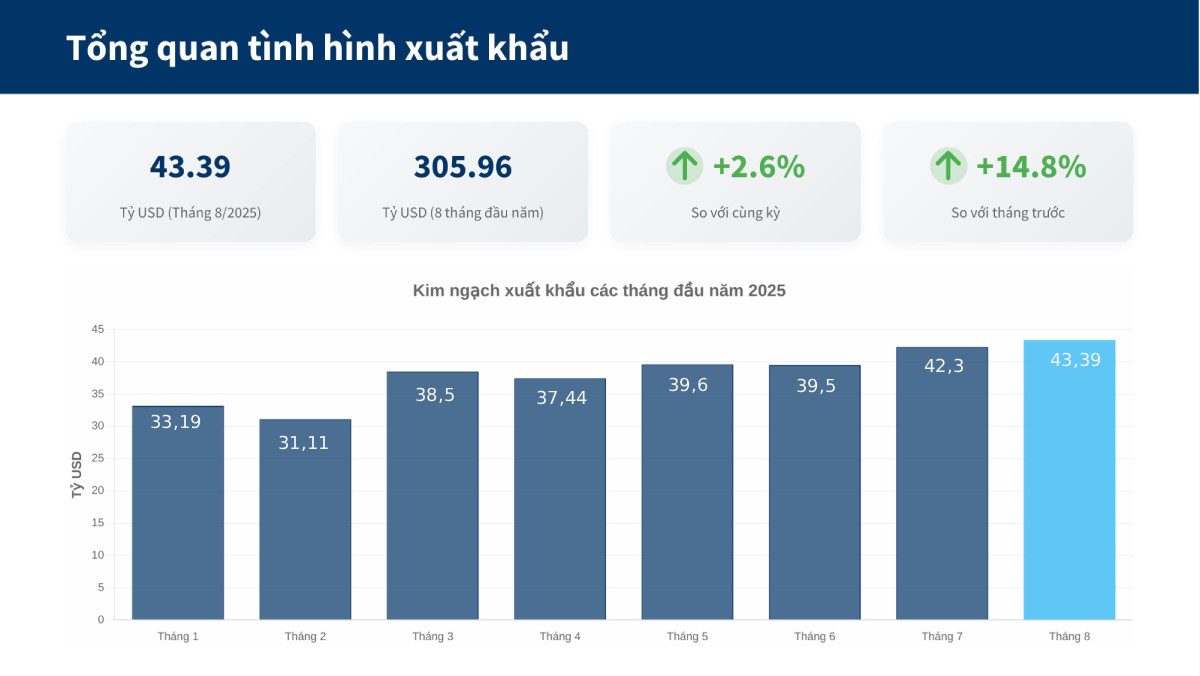
August 2025 marked a positive step forward as export turnover reached USD 43.39 billion, up 14.8% from the previous month. Cumulatively, exports in the first eight months of the year amounted to USD 305.96 billion, an increase of 2.6% year-on-year. Although cumulative growth remains modest, these figures demonstrate a gradual recovery of exports amid global economic volatility.

What were Vietnam’s top export products in the first 8 months of 2025?

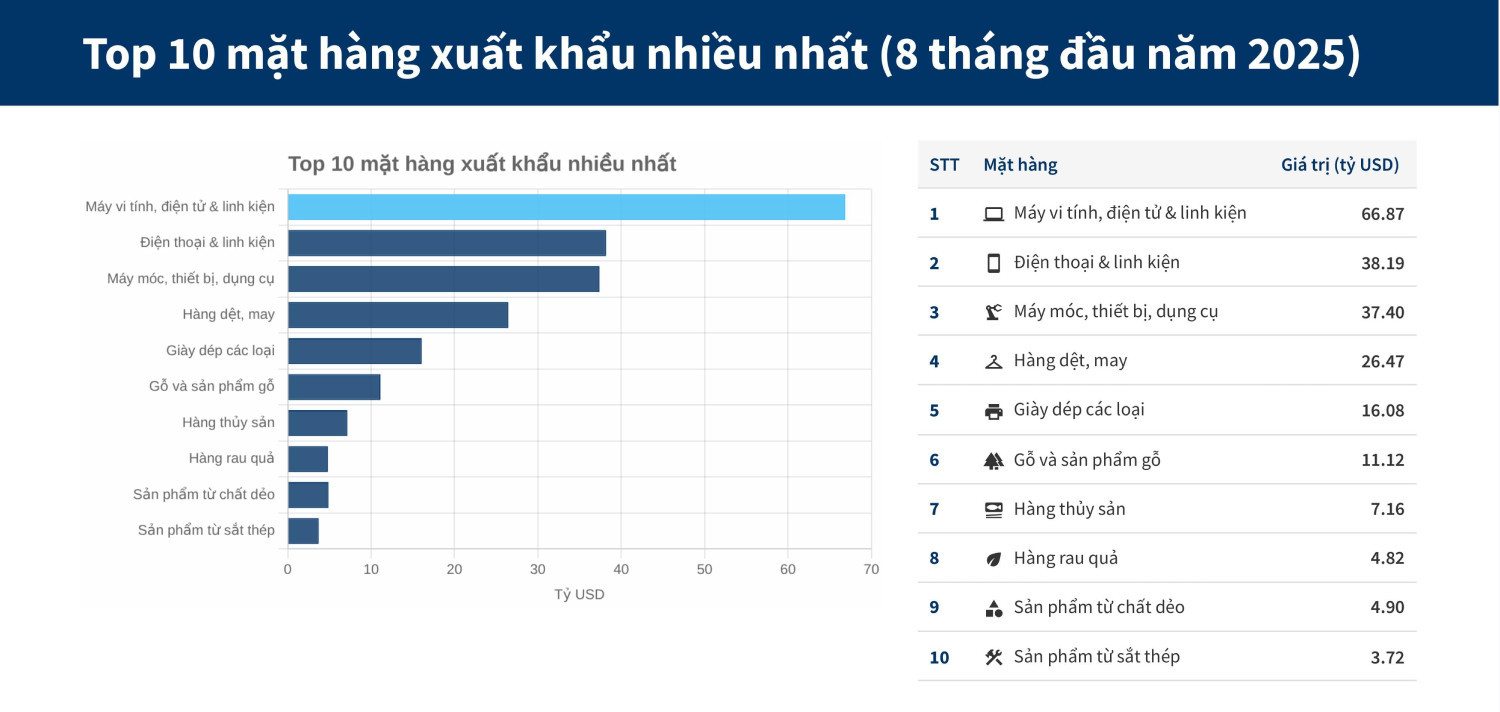
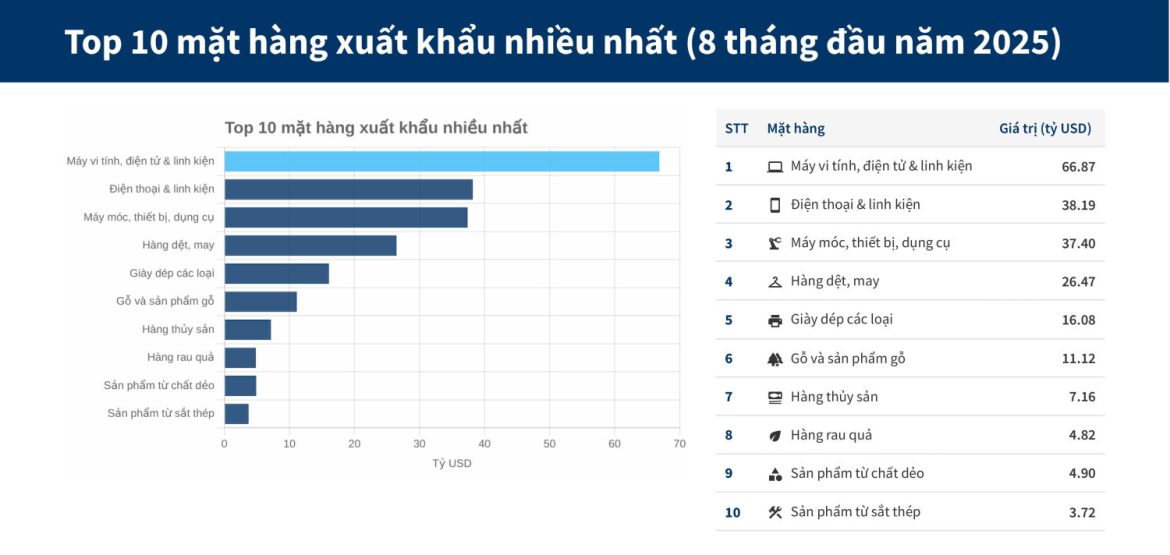
In the first eight months of 2025, Vietnam’s export structure was primarily driven by high-tech manufacturing and traditional agricultural products. High-tech goods, particularly computers, electronic products and components (USD 66.87 billion), telephones and components (USD 38.19 billion), and machinery, equipment, and parts (USD 37.40 billion), were the leading export categories by value. This dominance reflects stable foreign investment and the ongoing shift of global supply chains to Vietnam. Additionally, textiles and garments (USD 26.47 billion) and footwear (USD 16.08 billion) continued to be significant traditional exports, despite a slight slowdown in their growth.

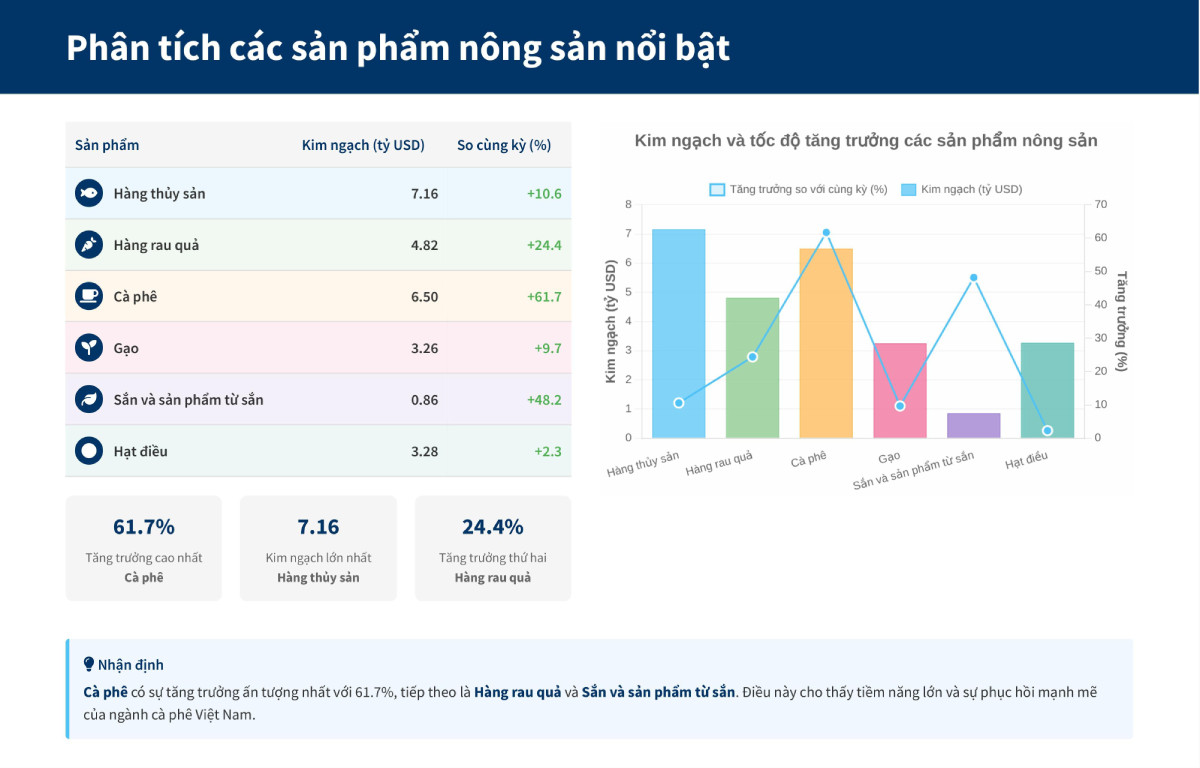
Notably, many agricultural commodities recorded impressive breakthroughs during the first eight months. Coffee exports surged to USD 6.50 billion, rising by 61.7% year-on-year, making it the brightest spot in the agricultural sector. Seafood maintained its leading position in this group with USD 7.16 billion (+10.6%). Fruits and vegetables reached USD 4.82 billion (+24.4%), reflecting sustained global demand for fresh and processed produce. Rice and cashew exports remained steady at USD 3.26 billion and USD 3.28 billion, respectively, while cassava and cassava-based products, though modest at USD 0.86 billion, grew sharply by 48.2%, demonstrating strong potential in this segment.

Which countries were Vietnam’s biggest export markets from January to August 2025?

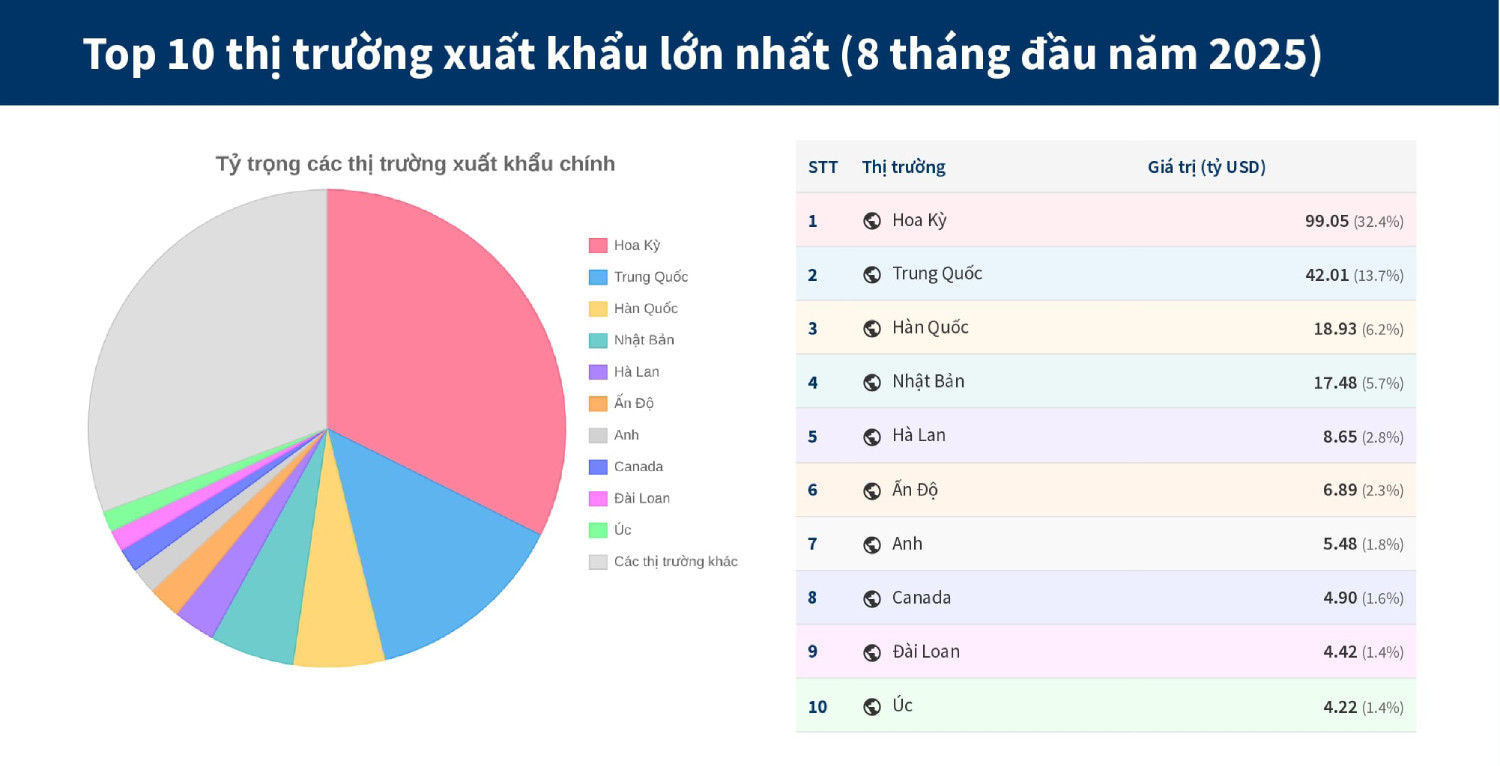
From January to August 2025, the United States was Vietnam’s largest export market, with exports totaling USD 99.05 billion, representing 32.4% of all exports. China followed as the second-largest market at USD 42.01 billion (13.7%). Other significant markets included South Korea (USD 18.93 billion), Japan (USD 17.48 billion), and the Netherlands (USD 8.65 billion). This market structure shows a high concentration, with the U.S. and China together accounting for nearly half of Vietnam’s total exports, which, while offering scale advantages, also presents risks related to potential trade policy shifts or geopolitical instability.

Opportunities and Challenges

Vietnam’s export performance during this period showed several bright spots. Total turnover continued to rise, high-tech commodities sustained robust growth, and agricultural products recovered strongly, particularly coffee, fruits and vegetables, and cassava. However, challenges remain: overall growth is still modest, some traditional commodities experienced fluctuations, and heavy reliance on a few major markets could pose long-term risks. Additionally, fierce competition from regional peers continues to exert pressure on Vietnam’s exports.

Outlook

Looking ahead, the outlook for the remainder of 2025 remains optimistic. Export turnover for the year is projected at USD 460–470 billion, with high-tech products expected to remain the main driver. At the same time, high-quality and sustainable agricultural goods are likely to gain wider access to emerging markets and those requiring stringent standards.

To seize opportunities and address challenges, Vietnam should focus on three key directions. First, strengthen its competitive advantages in high-tech industries and core agricultural exports. Second, improve quality and value-added in agriculture through deeper processing, traceability, and compliance with international standards. Third, diversify export markets to reduce dependence on the U.S. and China while maximising the benefits of FTAs to penetrate promising new destinations.

Conclusion

In summary, Vietnam’s exports in August and the first eight months of 2025 illustrate a clearer recovery trajectory, with high-tech products maintaining strong momentum and agriculture emerging as a new growth driver. The growing opportunities in both established and emerging markets provide a solid foundation for Vietnam to achieve stronger, more sustainable export growth and mark 2025 as a year of significant progress.

See more:

  • Vietnam’s Onions & Garlic: From Imports to Independence
  • Vietnam’s agricultural processing industry on the way to development
September 14, 2025 0 comment
0 FacebookTwitterLinkedinWhatsapp
Food & Spicy Industry

Vietnam’s Onions & Garlic: From Imports to Independence

by Henry Truong September 7, 2025
written by Henry Truong

Why does Vietnam import so much garlic when China dominates the global market?

Click HereClick Here

Despite China dominating the global garlic trade, accounting for 72% of the USD 4.3 billion market in 2024, Vietnam remains a significant importer. This reliance on imports highlights a gap in domestic supply and competitiveness, even as the global market sees 2.9 million tons exchanged annually, with other countries like Spain, Argentina, and the Netherlands holding smaller shares.

On the import side, the largest markets were Indonesia, Malaysia, the United States, and Vietnam. Notably, Vietnam ranked 4th globally, importing USD 300.8 million worth of garlic (over 263,000 tons) at an average price of USD 1,141/ton.

Meanwhile, Vietnam’s garlic exports remained very limited: only USD 6 million, less than 0.1% of global market share. Moreover, Vietnam’s garlic export price was about USD 655/ton—among the lowest worldwide. This reflects a significant competitiveness gap compared to other countries and highlights Vietnam’s heavy dependence on imported supply.

How does Vietnam’s onion import market compare to global leaders like the Netherlands?

Click HereClick Here

While the Netherlands leads the diversified global onion market with nearly 20% share of the USD 5 billion trade in 2024, Vietnam is also a significant importer. This contrasts with the more concentrated garlic market, as 9.8 million tons of onions are exported globally, with other key players including China, Mexico, India, the US, Pakistan, and Spain.

On the import side, the United States was the largest market (USD 521 million), followed by the UK, Malaysia, Canada, and Germany. Vietnam was also among the significant importers, with USD 163 million (about 316,000 tons) at an average price of USD 515/ton. However, Vietnam’s onion imports have been sharply declining: down 5% annually between 2020–2024, and down as much as 37% from 2023 to 2024.

What opportunities exist for Vietnamese garlic and onion farmers to reduce import reliance?

Significant opportunities exist for Vietnamese garlic and onion farmers to reduce import reliance, given the immense domestic demand. Vietnam annually imports approximately USD 301 million worth of garlic (around 264,000 tons) and USD 163 million worth of onions (about 317,000 tons). By focusing on replacing even a portion of these imports, farmers and enterprises can unlock substantial growth potential without immediately targeting exports. The primary strategy involves stabilizing domestic supply, reducing import dependency, standardizing quality, and achieving cost reductions through economies of scale, ultimately reclaiming market share in wholesale markets, supermarkets, industrial kitchens, and the processing industry.

For garlic, a two-tier approach is feasible: (1) expand mass garlic production in suitable regions to substitute imports for general consumption; (2) upgrade regional speciality garlic (Ly Son, Kinh Mon, Phan Rang) into premium segments with traceability, proper packaging, and brand protection. Once the domestic market is secured, niche export opportunities can be explored, such as processed and speciality products (black garlic, single-bulb garlic, dried garlic, garlic powder). Alongside improving seed quality, cultivation practices, and storage systems is crucial, as these bottlenecks currently inflate costs and cause significant post-harvest losses. FAO and multiple studies confirm that post-harvest losses in onions and garlic can be very high without proper drying and storage techniques, which increases costs and reduces quality.

For onions, 2024 data shows Vietnam’s imports are decreasing sharply—an opportunity to boost domestic production and replace imports in major consumption channels. Key areas such as Vinh Chau (Soc Trang) have successfully applied preservation technologies (curing, cold storage, sprout-inhibitor treatment) to reduce post-harvest losses and extend supply, making them well-suited to capture modern retail and long-term contracts. Once the domestic chain is stabilised, Vietnam could target niche exports to ASEAN and the Middle East with speciality purple onions and processed onion products.

How can Vietnam achieve independence in its garlic and onion markets?

Vietnam’s garlic and onion import figures reveal a paradox: despite favourable natural conditions and famous speciality varieties, the domestic market is still dominated by foreign products. To reverse this, Vietnam should adopt a “domestic-first, export-later” strategy: focus on organising large-scale production, standardising quality, reducing post-harvest losses, protecting regional brands, and strengthening processing to create added value. Only when the domestic market is firmly consolidated can Vietnamese farmers and enterprises confidently step into the global arena, unlocking sustainable export potential for these two essential products that are part of daily meals for billions of people worldwide.

See more: Vietnam’s agricultural processing industry on the way to development

September 7, 2025 0 comment
0 FacebookTwitterLinkedinWhatsapp
Market Insights

Vietnam’s agricultural processing industry on the way to development

by Henry Truong September 2, 2025
written by Henry Truong

The fact that agriculture continues to be affirmed as a “pillar” demonstrates that its function goes beyond direct economic value—it lies in the ability to secure food for over 100 million people, provide livelihoods, and maintain social stability, particularly amid global economic and political volatility. For agriculture to continue developing sustainably and effectively in an integrated economy, the shift from a purely production-based sector to one with high added value is imperative. In this context, agricultural production and processing companies play a pivotal role, acting as a driving force to transform raw resources into high-value products, enhancing competitiveness and positioning Vietnamese agricultural goods in the global market. In this article, we will explore the development journey of Vietnam’s agro-processing sector.

How did Vietnam’s agriculture transform between 1986 and 2000?

Between 1986 and 2000, Vietnam’s agriculture underwent a significant transformation, moving away from a centrally planned economy that had previously struggled with food shortages. Before the Đổi Mới reforms (1976–1986), the country’s average annual rice output was a mere 13–14 million tons, failing to meet the population’s needs.

A historic turning point came with the 6th National Congress of the Communist Party (1986), which initiated Đổi Mới, identifying agriculture as the “frontline sector.” Breakthrough policies were introduced, creating powerful momentum for production. Resolution 20-NQ/TW (1979) allowed a combination of planning and market mechanisms, the revival of private businesses, and authorised localities to engage in import-export activities. Later, Resolution 10-NQ/TW granted land-use rights to farming households, giving producers greater autonomy. Thanks to these policies, rice output soared to 21.5 million tons in 1989 and reached 32.55 million tons by 2000, transforming Vietnam from a food-deficient country into one of the world’s leading rice exporters.

The success of Đổi Mới policies in agriculture solved widespread food security and poverty issues. However, a structural consequence emerged: fragmented, small-scale production. The division of land among over 8.6 million farming households created a dispersed production system with weak linkages. This not only reduced productivity but also hindered the adoption of modern technologies, standardised quality control, and the building of efficient supply chains. Fragmentation was not a random limitation but a direct legacy of policies that successfully mobilised labour in the early stages, leaving a challenge to be addressed in the sector’s next phase of development.

What changes did Vietnam’s agricultural sector see from 2000 to 2020?

From 2000 to 2020, Vietnam’s agricultural sector experienced robust development and significant diversification, driven by deeper international economic integration. This era saw the emergence and growth of numerous agricultural production and processing enterprises, operating across various scales and business models. These developments opened substantial opportunities for exports, leading to an impressive increase in Vietnam’s agro-forestry-fishery export turnover, which surged from approximately USD 20 million in 1990 to over USD 53 billion by 2022.

Beyond value growth, agriculture diversified its product structure. Instead of focusing only on rice, Vietnam developed multiple billion-dollar export commodities, including wood and wood products, coffee, fruits and vegetables, and cashews. This diversification helped reduce risks associated with overreliance on a few products and expanded export markets, particularly in major destinations such as the U.S., China, and Japan.

The growth of the agro-processing industry is reflected in enterprise statistics. By the end of 2019, Vietnam had 7,471 agro-forestry-fishery enterprises—up 94.25% compared to the end of 2015, with an average annual increase of 906.3 enterprises. By Q1 2024, the number of newly established enterprises in agriculture, forestry, and fisheries had risen by 10% compared to the same period in 2023. Nationwide, the number of medium and large-scale agro-processing enterprises surpassed 2,100.

How is Vietnam’s agriculture evolving strategically since 2020?

Since 2020, Vietnamese agriculture has been undergoing a strategic evolution, shifting its mindset from mere “agricultural production” to a comprehensive “agricultural economy.” This strategic change prioritizes the integration of production with processing and market linkages, aiming to enhance the quality of growth and improve farmers’ incomes. The overarching goal is to establish a modern, market-oriented agricultural sector characterized by high productivity, superior quality, and strong competitiveness, positioning Vietnam as a leader in the region and globally.

Government policies have clearly reflected this orientation. The Strategy for Sustainable Agriculture and Rural Development 2021–2030, with a vision to 2050, sets targets of 2.5–3% annual GDP growth in agro-forestry-fisheries and 5–6% average annual growth in export value by 2030. Resolution 19-NQ/TW (2022) and the Government’s Action Program (26/NQ-CP) further reinforced this vision, designating it a central mission for agriculture, farmers, and rural development through 2030, with a vision to 2045.

Initial results in this phase are promising. In the first half of 2025, Vietnam’s agro-forestry-fishery sector recorded export values of approximately USD 33.84 billion, up 15.5% year-on-year. Agricultural products reached USD 18.46 billion (+17.8%), fisheries USD 5.16 billion (+16.9%), and forestry USD 8.82 billion (+9.3%). These figures indicate that the shift from quantity-driven to value-driven growth is progressing positively.

Conclusion

Vietnamese agriculture is clearly transitioning from a volume-based growth model to a value-driven development model, with a focus on deep processing, branding, and expanding access to premium markets. The initial achievements in major exports such as rice, coffee, fruits, and seafood demonstrate that this strategy is on the right track—helping raise farmers’ incomes, boosting competitiveness, and gradually affirming Vietnam’s position on the global agricultural map.

See More:

  • Restructuring Global Supply Chains in the Shadow of Geopolitics (Part 1)
  • Vietnam’s Processed Food Sector: Key Drivers of Export Growth
September 2, 2025 0 comment
0 FacebookTwitterLinkedinWhatsapp
Newer Posts
Older Posts

Recent Posts

  • Import Vietnamese Coffee: Your Strategic B2B Playbook
  • Vietnam’s Coffee Economy: Market Trends, Export, and Sustainable Future
  • Vietnamese Coffee Brands: Your Definitive Guide to Authentic Flavors, Top Picks & Smart Buying
  • Vietnamese Coffee Taste: Your Sensory Guide to Bold Flavors
  • Vietnamese Coffee: Ultimate Guide to History, Brews & Global Impact

Follow Us

Facebook Linkedin Twitter

Recent Posts

  • Import Vietnamese Coffee: Your Strategic B2B Playbook

    December 17, 2025
  • Vietnam’s Coffee Economy: Market Trends, Export, and Sustainable Future

    December 15, 2025
  • Vietnamese Coffee Brands: Your Definitive Guide to Authentic Flavors, Top Picks & Smart Buying

    December 13, 2025
  • Vietnamese Coffee Taste: Your Sensory Guide to Bold Flavors

    December 12, 2025
  • Vietnamese Coffee: Ultimate Guide to History, Brews & Global Impact

    December 11, 2025

Categories

  • Food & Spicy Industry (30)
  • Free Trade Agreement (18)
  • Fruit & Vegetable (56)
  • Garment & Footwear (11)
  • Market Insights (29)
  • Others (4)
  • Seafood (4)
  • Vietnam Commodity Market Price (17)
  • Vietnam Export Data (15)
  • Vietnam Market (6)
  • Wood & Furniture (19)

Vietnam Commodity Export offers comprehensive and in-depth information on Vietnam’s sourcing market, highlighting opportunities and challenges across various industries. We help international businesses find quality manufacturers and reliable suppliers in Vietnam, providing the critical insights needed to connect with the best partners and resources in the market.

Newsletter Subscribe
    • Homepage
    • Market Insight
    • Sourcing Service
    • Vietnam Overview
    • Publication
    • About Us
    • Contact Us
  • Product Catalogue
    • Coconut Products
    • Tropical Fruits
    • Spicy Products
    • Food & Nuts Products
    • Dried Fruit

You are looking for suppliers in Vietnam!

Shop Now
Facebook Linkedin Twitter Email
VNCOMMEX Group Co. Ltd Address: 06 Vo Van Kiet, Nguyen Thai Binh Ward, District 1, HCMC
Email: info@vncommex.com

All rights reserved. Designed and developed by Vietnam Commodity Exports

Privacy Policy

FAQ

VnCommEx
  • VCE
  • Product Catalogue
  • Market Insight
    • Wood & Furniture
    • Garment & Footwear
    • Food & Spicy Industry
    • Fruit & Vegetable
    • Others
    • Market Insights
  • Vietnam Market
    • Vietnam Commodity Market Price
    • Vietnam Export Data
    • Vietnam in FTA
  • Publication
  • About Us
  • English
    • 中文 (中国)
    • Tiếng Việt
VnCommEx
  • VCE
  • Product Catalogue
  • Market Insight
    • Wood & Furniture
    • Garment & Footwear
    • Food & Spicy Industry
    • Fruit & Vegetable
    • Others
    • Market Insights
  • Vietnam Market
    • Vietnam Commodity Market Price
    • Vietnam Export Data
    • Vietnam in FTA
  • Publication
  • About Us
  • English
    • 中文 (中国)
    • Tiếng Việt
@2021 - All Right Reserved. Designed and Developed by PenciDesign
✕

Shopping Cart

Close
No products in the cart.
Close
 
Return to shop