

2025 marks a significant turning point for Vietnam’s economy, with a series of new policies and public investment projects aimed at boosting strong growth, particularly in the agricultural sector. As one of Vietnam’s key export industries, the cashew sector faces both major opportunities and challenges from this new wave of policies, which focus on three key pillars:
- Upgrading Logistics Infrastructure: Investment in transportation and port infrastructure is expected to significantly reduce shipping costs—a long-standing bottleneck that has hampered the industry’s competitiveness.
- Deep Processing Revolution: The push for advanced technology and deep processing aims to increase the added value of cashew products, reducing the industry’s reliance on raw exports.
- Export Market Diversification: Enhanced trade promotion and market diversification efforts are intended to mitigate the risks associated with over-reliance on a few traditional markets.
Despite these promising prospects, the cashew industry faces significant hurdles. These include the risk of slow disbursement of public project funds, strict technical and tariff barriers in major markets like the EU and the US, and especially a heavy dependence (around 90%) on imported raw materials—a critical strategic weakness.
How will Vietnam’s 2024-2025 monetary policy affect the cashew industry?
Vietnam’s 2024-2025 monetary policy, set by the State Bank of Vietnam (SBV), is designed to foster macroeconomic stability and economic growth, directly impacting the cashew industry. This policy aims for an 8% GDP growth and inflation below 4%.
- GDP Growth: 8%
- Inflation Control: Below 4%
To achieve these goals, the SBV has implemented several adjustments. As of July 31, 2025, the average lending interest rate for new transactions has decreased to 6.5% per annum, making it easier for businesses to access capital. At the same time, preferential credit packages for the agricultural sector have been rolled out, helping businesses reduce production and investment costs.
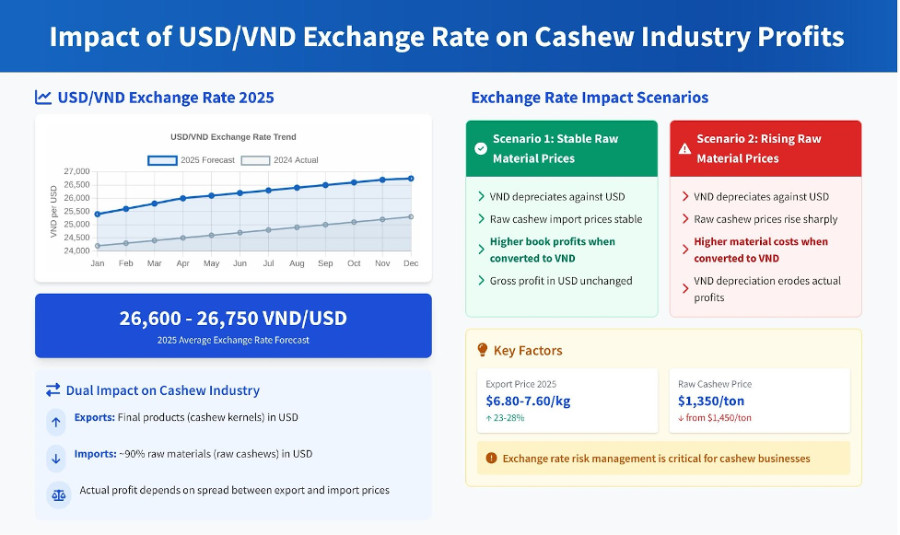
However, a key factor with complex and multifaceted effects on the cashew industry is the exchange rate. Cashew is a unique commodity: it exports the final product (cashew kernels) in USD while also importing the majority of its raw materials (raw cashews) in USD. Therefore, fluctuations in the USD/VND exchange rate are not just an export advantage but also create dual pressure on profitability.
How does the USD/VND exchange rate impact cashew business profitability?
The USD/VND exchange rate significantly influences the profitability of cashew businesses, especially given the industry’s unique position of both importing raw materials and exporting finished products in USD. A weakening Vietnamese Dong (VND), as observed with the reference exchange rate of 25,245 on August 18, 2025, and bank rates between 26,090 and 26,450, theoretically boosts export revenue when converted to VND, creating a ‘paper profit’.
However, since the cashew industry relies on imported raw materials for up to 90% of its needs, input costs also rise proportionally when converted to VND. Actual profitability depends on the difference between the export price of cashew kernels and the import cost of raw cashews.
Scenario 1: Stable Raw Material Prices
If the import price of raw cashews remains relatively stable, a depreciating VND could yield a certain level of paper profit for exporting businesses. The gross profit in USD would remain unchanged, but when converted to VND, it would be higher.
Scenario 2: Sharply Rising Raw Material Prices Not Aligned with Export Prices
This is the riskiest scenario. When the price of raw cashews increases significantly, the cost of raw materials to produce one ton of cashew kernels also rises. The depreciation of the VND would then amplify this cost when converted, eroding the business’s actual profit. In this case, the weakening VND is no longer an advantage but a factor that depletes profitability.
Therefore, cashew exporters need to manage exchange rate risks tightly. Strategic solutions like market diversification, supply chain optimisation, and investing in deep processing are crucial for the industry to overcome exchange rate challenges and maintain a competitive edge in a volatile economic landscape.
How will public investment in infrastructure boost Vietnam’s cashew industry?
Public investment in Vietnam’s transportation infrastructure and logistics systems is set to significantly boost the cashew import-export industry by directly addressing its primary bottleneck: high transportation costs. These strategic projects aim to connect key production regions more efficiently, thereby reducing both the cost and time involved in transporting goods, particularly exported cashews.
In Binh Phuoc, the cashew capital of the country, two strategic expressways are currently under development: the Gia Nghia – Chon Thanh and the Ho Chi Minh City – Thu Dau Mot – Chon Thanh routes. With a total investment of tens of trillions of VND, these expressways, once completed, will create a seamless transportation corridor directly linking the Central Highlands (Dak Nong) and Southeast (Binh Phuoc) raw material regions with major seaports like Cai Mep – Thi Vai and Ho Chi Minh City.
Prioritizing budget allocation for these key transportation projects is expected to help reduce logistics costs for businesses by 15-20%, thereby significantly boosting the competitiveness of Vietnamese cashews in the international market.
See further: How long can Vietnam maintain its dominance in the cashew industry?
How is Vietnam enhancing cashew value through technology and deep processing?
In addition to physical infrastructure, the government is also tackling two core issues for the cashew industry: low productivity and low added value. The goal is to transform the sector from a raw-export-dependent industry into a more sustainable, efficient, and deep-processing one.
New policies are encouraging the application of science, technology, and smart agriculture. A prime example is the program to replant nearly 2,500 hectares of old cashew trees in Binh Phuoc with new, high-yield varieties, providing seedlings to poor and ethnic minority households. This long-term strategy aims to reduce the industry’s reliance on imported raw materials and improve the quality of domestic cashews.
Furthermore, a significant portion of the Economic Recovery Program budget is dedicated to helping businesses invest in modern production lines. The objective is to increase the proportion of deep-processed products like cashew butter and cashew milk to 30% of the total export value by 2025.
To expand markets, the government is also sponsoring the “International Cashew Conference” in Hanoi in the fourth quarter of 2025. This event will provide an opportunity for Vietnamese businesses to connect directly with potential importers from Europe and the Middle East. This strategic move aims to diversify export markets, mitigate risks, and promote sustainable growth for the entire industry.
What is the market outlook and export price forecast for Vietnamese cashews?
The market outlook for Vietnamese cashews remains highly positive, with the global cashew market projected to reach nearly $10 billion, and the deep-processed segment comprising over half of this value. This trend strongly supports Vietnam’s strategic focus on deep processing. Furthermore, export prices for cashew kernels, particularly the common WW320 type, have seen a robust year-on-year increase of 23-28%, now ranging from $6.80–$7.60 per kg. This significant price surge indicates strong market demand and is expected to substantially boost revenue and profitability for Vietnamese exporters, reinforcing the industry’s confidence in achieving its annual export target of $4.5 billion despite market volatility.
In terms of supply, raw cashew production from major growing nations like Ivory Coast and Cambodia has reached record highs, at 1.3–1.5 million tons and 850,000–900,000 tons, respectively. Additionally, Vietnamese cashew exporters are actively exploring and expanding into new markets. China has emerged as a bright spot, with its import value growing by over 41% in 2025. This presents a golden opportunity for Vietnam to boost its exports, offsetting challenges in the U.S. market.
Meanwhile, the European Union (EU) remains a key market, accounting for over 70% of Vietnam’s total cashew imports. With major markets like Germany and the Netherlands, and particularly the strong growth in the organic cashew segment, the EU is not only a stable market but also a place where Vietnam can assert its position on product quality.
In summary, 2025 is a pivotal year for the cashew industry, with opportunities and challenges intertwined. Grasping market signals, optimising the supply chain, and implementing flexible market diversification strategies will be key for Vietnam’s cashew industry to maintain and strengthen its leading position in the global market.
See more: The Landscape of Vietnam’s Cashew Exports to China: Data and Trends


