

What is the global coconut market outlook?
Coconut is more than just a fruit; it’s a powerhouse of benefits, offering valuable resources from its shell, pulp, and water to its trees and leaves. This remarkable versatility allows coconut products to thrive in diverse sectors, including food, cosmetics, healthcare, and artisanal crafts. With the global coconut market projected to soar from USD 29.9 billion in 2024 to USD 55.1 billion by 2032—an impressive compound annual growth rate (CAGR) of 8.1%—the growth potential is enormous.
Among the coconut products, coconut oil shines brightly, accounting for a substantial 55% of global revenue. Its popularity in cosmetics stems from its exceptional properties, such as nourishing hair, combating ageing, and providing antibacterial and anti-inflammatory benefits. Countries like India and China have embraced coconut oil not only for beauty but also as a staple in culinary practices, enhancing dishes with its rich flavour.
On the rise is coconut water, set to become the fastest-growing segment with a remarkable CAGR of 9.4%. Post-pandemic, consumers have increasingly turned to natural health alternatives, particularly in Europe and North America. With its natural electrolytes and zero added sugars, coconut water is a refreshing and healthy substitute for conventional sports drinks, catering to health-conscious consumers.

The coconut market is brimming with potential, presenting a wealth of opportunities for businesses eager to capture market share in Europe and the Americas. For importers, choosing the right sourcing country can be a game-changer. This article will delve into the strengths and advantages of the top coconut-exporting nations, providing insights that empower businesses to make informed sourcing decisions and tap into this lucrative market.
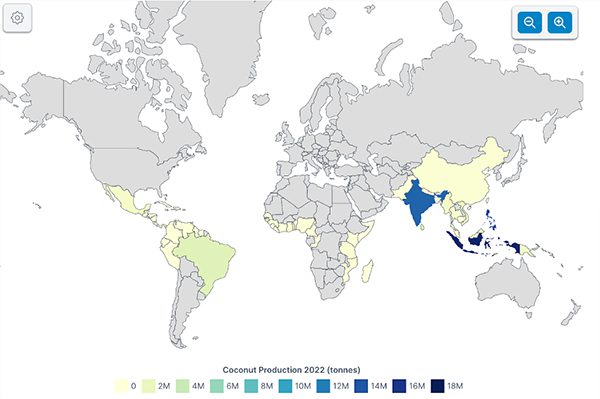
Which countries are the top coconut exporters globally?
What is the current state of Indonesia’s coconut industry?
Indonesia’s coconut industry is a global powerhouse, ranking as the second-largest producer worldwide in 2023, just behind the Philippines. The nation achieved an impressive export volume of 2.83 million tons, generating a staggering $1.55 billion from coconut product exports and capturing 38.3% of the global market share. With a consistent annual total coconut production of approximately 17 million tons since 2018, Indonesia demonstrates significant strength in both domestic consumption and international trade.

Key Export Products and Dynamic Markets
Indonesia’s coconut exports are diverse, with major markets including China, Malaysia, and Singapore. The standout products in this booming industry include:
- Coconut Oil and Processed Coconut Oil: Representing a significant portion of export revenue.
- Coconut Shell Charcoal: Sought after for its various industrial applications.
- Shredded Coconut: Popular in both culinary and snack sectors.
- Coconut Fiber: Used extensively in eco-friendly products and gardening.
Despite its strengths, Indonesia’s fresh coconut exports are comparatively modest, with the total value of fresh and dried coconuts (classified under HS code 080110) reaching only $277 million in 2023. This accounts for a mere 18% of the nation’s overall coconut export turnover, highlighting a potential area for growth.
Production Landscape
Approximately 93% of Indonesia’s coconuts are cultivated by smallholder farmers. The Riau province is the heart of Indonesia’s coconut production, contributing 14.31% of the total coconut-growing area. Other notable provinces include:
- North Sulawesi: 9.3%
- East Java: 8.89%
- North Maluku: 7.97%
- Central Sulawesi: 6.02%
- Central Java: 5.99%
- Jambi: 3.66%
- Maluku: 3.29%
- Lampung: 3.24%
- West Java: 3%
Leading Coconut Varieties
The Genjah coconut, or dwarf coconut, is Indonesia’s most exported coconut variety. This variety is highly valued for its fast growth, high productivity, and substantial oil content, making it ideal for producing coconut oil and dried coconut—both of which have a strong international market demand. A single Genjah coconut tree can yield an impressive 80-100 fruits per year, with a short harvest time of just 3-4 years.
In addition to Genjah coconuts, Pandan Wangi and Thai coconuts (Nam Hom) are also exported as fresh coconuts due to their unique flavours. However, their output is not as significant as that of Genjah coconuts, as the demand for fresh coconuts tends to be lower compared to the demand for coconut oil and dried coconut.

How does the Philippines contribute to the global coconut export market?
The Philippines is a leading player in the global coconut export market, engaged in a dynamic rivalry with Indonesia for top supremacy. The coconut industry is a vital component of the Philippine economy, contributing 35% to the nation’s total agricultural export turnover. In 2022, the country achieved a remarkable coconut export turnover of $3.2 billion, accounting for 43% of all agricultural exports, underscoring its significant contribution to the global market.
Philippine Agriculture Secretary Tiu Laurel aptly encapsulated the significance of this industry: “The coconut tree is not only a symbol of our rich agricultural heritage; it is a powerhouse of Philippine agriculture. Currently, we export more than 50% of our coconut products, generating over a billion dollars annually from crude coconut oil alone.” This highlights the essential role of coconuts not just as an economic asset, but as a cornerstone of Filipino culture and livelihoods.
Export Highlights
Coconut oil stands as the Philippines’ primary export product, showcasing the country’s prowess in the global coconut market. According to the Philippine Statistics Authority (PSA), the nation exported 1.129 million tons of coconut oil last year, a slight decline from 1.252 million tons in 2022. Despite this dip, export turnover fluctuated between $1.7 billion and $2.5 billion, solidifying the Philippines’ position as the second-largest exporter of coconut oil globally. In 2022, coconut oil ranked as the seventh-largest export product from the Philippines, highlighting its significance to the national economy.
The main destinations for Philippine coconut oil include:
- Netherlands: $597 million
- United States: $426 million
- Malaysia: $198 million
- China: $182 million
- Germany: $167 million
Notably, exports to China have surged by 27% over the past three years, marking the highest growth rate among all countries and securing China’s place among the top five export markets.
Following coconut oil, the desiccated coconut sector contributes an impressive $350 to $400 million annually, while coconut oil cake adds about $67 million to export earnings. However, Philippine coconut water remains relatively niche, with an export turnover of just $11 million. According to EUROSTAT, the European Union imported 105,104 tons of coconut products from outside the EU, valued at €146 million in 2023. The Philippines plays a crucial role in this market, accounting for 40% of total coconut imports into the EU, underlining its importance as a key supplier on the global stage.

Coconut growing area
The Davao Region stands out as the leading coconut-producing area in the Philippines, contributing 487.10 thousand tons to the national yield, which accounted for 15% of the country’s total coconut production in the first quarter of 2023. Following closely are the Zamboanga Peninsula and Northern Mindanao, holding 14.9% and 13.6% of the market share, respectively. This highlights the critical role that Davao and its neighbouring regions play in the nation’s coconut industry.
To cater to various export needs, the Philippines utilizes distinct coconut varieties:
- Tacunan Dwarf Coconut: Grows 6-8 meters tall, is known for its oily meat, and is primarily used for coconut water and oil.
- Catigan Dwarf Coconut: Oval-shaped fruit ideal for coconut water, meat, and rich oil extraction.
- Aromatic Sweet Dwarf Coconut: Produces sweet meat, commonly used for coconut sugar and coconut milk.
Recognizing the importance of coconuts to the economy and the livelihoods of millions, the Philippine government has initiated the 100 Million Coconut Planting Program. This effort aims to revitalize the coconut industry and support approximately 25 million Filipinos who rely on coconut cultivation, making it truly a national treasure.
What is the current status of India’s coconut industry?
India’s coconut industry holds a significant position as the third-largest producer globally, boasting an impressive annual output of approximately 21.5 billion tonnes. Coconuts are vital to India’s export economy, with total coconut exports experiencing a compound annual growth rate (CAGR) of 13% from 2015-16 to 2021-22. This robust growth trajectory led to India achieving $452 million in coconut product exports by 2023, highlighting its importance in the international market.
The primary coconut exports include coir, desiccated coconut, and fresh coconuts. India ships these products to over 140 countries, with Vietnam, the UAE, Bangladesh, Malaysia, and the United States as the top importers. In 2020-21, exports to these five countries totalled $77 million, comprising 66% of India’s total coconut exports. Vietnam is the largest importer, capturing a 25% market share, followed by the UAE (14%) and Bangladesh (12%).

Production Landscape
Coconut production is mainly concentrated in the southern states, including Kerala, Karnataka, Tamil Nadu, and Andhra Pradesh, which account for 89.4% of the coconut area and 90.9% of total production in FY 2022-23. Despite this concentration, production has only grown at a CAGR of 2.9% from 2001-02 to 2022-23, primarily due to productivity improvements. From 2011-12 to 2022-23, coconut production saw a decline of -1.1%, with productivity also dropping by -1.5%. This decline reflects the saturation of existing plantations without expansion. The highest coconut production was 16.5 million tonnes in 2016-17, but this figure has since decreased, hitting a decade low of 13.3 million tonnes in 2021-22.
According to the Coconut Development Board (CDB), approximately 12% of the total coconut harvest is consumed as young coconuts for drinking. The remaining coconuts are used as mature coconuts for both domestic and industrial purposes. Although the COVID-19 pandemic caused disruptions in supply chains and logistics, leading to a decline in the consumption of young coconuts, demand has begun to recover, although it remains below pre-pandemic levels. Additionally, less than 15% of coconuts are utilized for value-added products such as desiccated coconut, virgin coconut oil, coconut milk, and coconut water.
Desiccated coconut is a significant export product for India, primarily available in two forms: desiccated coconut and copra pellets. Desiccated coconut is commonly used for oil extraction, while copra pellets are consumed as a dry fruit and are also used in religious practices. According to CDB estimates, about 45.8% of total coconut production in India is allocated for making copra, with 33% used for grated coconut and 12.8% for copra pellets. The production of grated coconut is primarily concentrated in Kerala and Tamil Nadu, highlighting the regional significance of these states in the coconut industry.
How is Vietnam’s coconut industry growing in global production and exports?
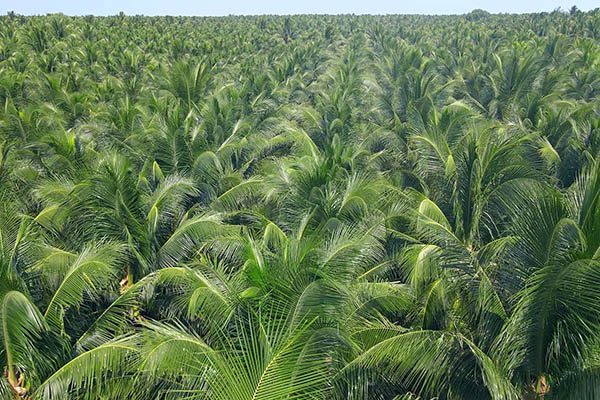
Coconut is a vital industrial crop in Vietnam, ranking fourth globally among key agricultural plants alongside coffee, rubber, tea, cashew, and pepper. With about 194,286 hectares dedicated to coconut cultivation, primarily concentrated in the Mekong Delta, Vietnam ranks fifth worldwide in coconut growing area. The country’s high productivity, averaging 118 quintals per hectare, enables annual production of 1.9 to 2 million tons of coconuts.
Ben Tre is the largest coconut-growing province, covering nearly 80,000 hectares and accounting for about 42% of the national coconut area. This province produces approximately 700 million coconuts annually, with 85% processed for domestic consumption and export. Ben Tre hosts 32 cooperative groups and 34 cooperatives involved in value chain linkages, covering 13,297 hectares and comprising 6,556 members. Notably, around 20,400 hectares (25% of the province’s coconut area) is cultivated according to organic standards, with 13,000 hectares certified by international standards from the US, Japan, EU, China, Korea, and Taiwan.
Vietnam’s coconut products are exported to over 90 countries and territories, with coconut export turnover in 2023 reaching $420 million, making up 27.45% of the province’s total export revenue. The average annual export turnover for all coconut products stands at $1.065 billion, expected to rise to $1.2 billion by 2024, following the signing of an official export protocol with China.
Currently, Vietnam has approximately 854 enterprises engaged in the manufacturing and processing of coconut products, covering various types and scales. Key industries include:
- Coconut shell processing: Production of coconut fibre, coco peat, and related products.
- Coconut shell processing: Including activated carbon, sintered coal, and coconut handicrafts.
- Coconut rice processing: Preliminary processing of desiccated coconut, coconut milk, coconut milk powder, coconut oil, coconut candy, and coconut cosmetics.
- Coconut water processing: Including coconut jelly and canned coconut water.

The coconut industry represents 28.52% of all enterprises in Vietnam’s industrial production sector, providing employment for over 15,000 workers. The primary export products include desiccated coconut, fresh coconuts, activated carbon, and coconut candy.

Conclusion
The coconut industry is a critical agricultural sector in Vietnam, India, Indonesia, and the Philippines, each contributing uniquely to the global coconut market. Vietnam and the Philippines excel in fresh coconut and value-added products, while India and Indonesia leverage their extensive production capacities and established export channels. Trade agreements and a focus on sustainability and innovation across these countries will continue to drive growth and enhance competitiveness in the international coconut market, ensuring that coconuts remain a vital agricultural commodity worldwide.


