TABLE OF CONTENT

Part I: Global Processed Cashew Nuts Market Outlook: Trends, Forecasts, and Key Growth Drivers

Part II: Detailed Exploration of Key Consumption Markets (2025–2026)

Part III: Decoding the Billion-Dollar Markets for Processed Cashew Imports

Part IV: Analysing the Competitiveness of Vietnam’s Cashew Industry: From Rapid Rise to New Challenges

Part V: Cost Constituting Vietnam’s Cashew Nut Export Price (FOB)

Part VI: The Impact of the Intermediary Chain on Vietnam’s Cashew Nut Export Price

Part VII: Comparing Raw Cashew Nut Quality from Leading Sources: Cambodia, Ivory Coast, and Tanzania

Part VIII: Analysing Vietnam’s Competitors in the Global Cashew Nut Market

Part IX: Global Cashew Nuts Market Competition Trends and Forecast 2025- 2026

Cashew Nuts Import & Export Market 2025 Report

96,28 USD

CASHEW NUTS IMPORT & EXPORT MARKET 2025 REPORT

Facebook
LinkedIn
X

Cashew Nuts Import & Export Market 2025 Report

Foreword

The global processed cashew market is undergoing a significant transformation, driven by rising demand for healthy food, continuous product innovation, and the restructuring of global supply chains. In this dynamic context, Vietnam—one of the world’s key players in cashew processing and exports—faces both promising opportunities and growing challenges from shifting consumer trends, geopolitical competition, and rising input costs.

This report aims to deliver a comprehensive and up-to-date overview of the global import-export cashew nuts market for the 2025–2026 period, with a focus on:

  • Analysing major growth drivers, consumption trends, and supply chain shifts;

  • Providing in-depth insights into key consumer markets across North America, Europe, Asia, and Oceania;

  • Evaluating Vietnam’s competitive position, from its “raw-import, value-added-export” model to its cost structure (FOB);

  • Decoding the impact of intermediary chains, logistics costs, labour, and raw material sourcing on export prices;

  • Comparing the quality of raw cashews from leading suppliers such as Cambodia, Côte d’Ivoire, and Tanzania;

  • Assessing global competitors and their strategies in the evolving cashew trade landscape.

Through deep-dive market analysis, this report serves as a valuable resource for exporters, importers, investors, and policymakers to navigate the shifting dynamics of the global cashew industry and make informed strategic decisions in a post-pandemic, economically uncertain world.

Forecast of global cashew consumption growth

The global processed cashew nuts market is experiencing robust growth, driven by rising consumer demand for plant-based proteins, expanding snack food categories, and increased health awareness. Market research across multiple sources highlights positive post-COVID recovery and long-term expansion trends, with varying projections based on geographic focus and market segmentation.

According to Future Market Insights, the global processed cashew market is projected to grow from USD 5.93 billion in 2025 to USD 10.41 billion by 2035, achieving a compound annual growth rate (CAGR) of 5.8%. Virtue Market Research, meanwhile, offers a more aggressive outlook, forecasting the broader cashew market to expand from USD 10.5 billion in 2023 to USD 15.43 billion by 2030, with a CAGR of 5.65%. However, another report from the same firm presents a more conservative estimate, placing the processed cashew segment at USD 7.32 billion in 2023, growing at 4.6% CAGR, reflecting methodological and scope variations across reports.

…….

Import Market Analysis by Region

The global cashew import market demonstrates a distinct regional distribution, shaped by both processing capacity and consumption demand.

  • Asia is the largest import region, accounting for 57.9% of global cashew import value. This dominance is primarily driven by Vietnam and India, which import large volumes of raw cashew nuts to support their processing and re-export industries. These two countries are recognised as global leaders in cashew processing and value chain integration.
  • The Middle East has emerged as a high-growth consumption market, bucking global trends. Over the past five years, cashew imports in the region have doubled, now making up approximately 15% of global imports. This surge is attributed to rising consumer demand, premium retail positioning, and a shift toward healthy snacking habits.
  • Europe ranks as the second-largest import market, with a 24.4% share of global imports. The region’s demand is driven by retail distribution and use in the food manufacturing industry, particularly in applications like snack foods, bakery, and confectionery.
  • North America (United States and Canada) and Oceania (notably Australia and New Zealand) collectively account for 16.2% of imports. These mature consumer markets exhibit strong demand for ready-to-eat, organic, and value-added cashew products, supported by well-established retail infrastructure and high health consciousness.
  • Africa and Latin America remain emerging markets, currently representing just 1.1% and 0.4% of global cashew imports, respectively. However, rising disposable incomes, urbanization, and nutritional awareness in these regions suggest long-term growth potential, especially as local food processing and retail channels evolve.

Part III: Decoding the Billion-Dollar Markets for Processed Cashew Imports

The global cashew supply chain is characterized by a highly fragmented geographical structure. While more than 90% of raw cashew nuts (RCN) are produced in Africa and South Asia, the bulk of processing—approximately 65–70% of global volume—is concentrated in Vietnam and India. This creates a distinctive triangular trade pattern: Raw materials from Africa → Processing in Asia → Final consumption in the West.

Within this framework, the European Union (EU) emerges as the largest global importer of processed cashew nuts, accounting for approximately 40% of total global imports. This far exceeds the United States, which holds the second position with a 28.5% share of global imports.

1. EU Cashew Nut Market: Strong Growth and Shifting Supply Dynamics

Following a temporary slowdown caused by the economic effects of the COVID-19 pandemic, the European Union’s cashew market has rebounded sharply. Imports rose by 9% in 2023, followed by an even stronger 11% increase in 2024, reaching 185,189 tons with a total value of €1.027 billion.

This growth trajectory has continued into 2025. In Q1 2025, the EU recorded its highest-ever quarterly import volume of cashew nuts at 42,850 tons—a 16% increase in volume and an impressive 42% increase in value compared to the same period in 2024.

The snack segment dominates demand, accounting for approximately 90% of imported cashew usage. This demand pattern creates a seasonal import cycle, with volumes typically peaking between September and November to prepare for the festive and winter seasons.

With the current momentum, total EU imports are projected to grow by around 20% in 2025, further solidifying the region’s position as the world’s largest market for processed cashew nuts.

1.1 Germany’s Cashew Market: Steady Long-Term Growth, Periodic Volatility

Germany stands out as both a major consumer and a key distribution hub, handling around 53% of all cashew circulation within the EU. Over the past decade, the market has followed a strong upward trajectory, with imports rising from 28.1 million kg in 2013 to 61.4 million kg in 2023, reflecting a CAGR of 4.8%.

The period from 2019 to 2020 marked a turning point, with a 25% surge in 2019 and a record high of 65,648 tons in 2020, largely fueled by the EU-Vietnam Free Trade Agreement (EVFTA), which facilitated smoother and more cost-effective trade flows from Vietnam.

…..

1.3 UK Cashew Market: Steady Growth and Strong Domestic Demand

Between 2015 and 2024, the UK maintained stable annual cashew imports, consistently ranging between 17,000 and 19,000 tonnes (equivalent to 17–19 million kilograms). From 2018 to 2023, the market recorded a compound annual growth rate (CAGR) of 2.62%, indicating a mature market with well-established consumption habits.

Although the UK has participated in re-exporting cashews, its role in this area has diminished over time. During the period 2015–2020, re-exports made up around 10% of total imports, but in recent years, this share has dropped to just 5–7%.

This shift is largely due to rising domestic demand. The growing popularity of healthy eating trends, especially flexitarianism, has led more consumers to include nuts like cashews in their diets as a plant-based protein source. As a result, most of the imported cashews are now consumed within the country, rather than being re-exported.

1.2 The Netherlands Cashew Import Market: Europe’s Leading Re-Export Hub

The Netherlands holds a strategic role in the European cashew industry—not as a key consumption market, but as a crucial import and re-export gateway, coordinating cashew flows across the continent. Its logistical strength and favourable trade infrastructure have solidified its status as Europe’s premier cashew trading hub.

Over the last decade (2015–2024), the Netherlands’ import volume has remained stable within the range of 40,000–50,000 tons annually, but the market has been shaped by several pivotal developments:

….

1.5 Spain Cashew Nut Market: Rapid Expansion and Strategic Role in Europe

Spain has emerged as one of the fastest-growing cashew markets in Europe, mirroring the continent’s broader shift toward sustainable, plant-based food consumption. With the European cashew market projected to reach USD 2.03 billion by 2029 (CAGR 4.48%), Spain stands out for its explosive import growth and strategic position as a regional gateway.

Spanish cashew imports have increased fivefold over the past decade, rising from 5.8 million kg to 21 million kg by 2024. The post-COVID era, in particular, has accelerated this trend, with annual growth averaging 30% since 2022. This reflects a strong consumer shift toward plant-based diets, with per capita nut consumption in Europe rising 12% between 2019 and 2021.

In 2024, Spain hit a new high, importing 21 million kg of cashews—a 38.6% increase in volume, with a total value of USD 131 million (+26.7% year-on-year). The bulk of imports is concentrated in Valencia (€74.3M), Alicante (€14.6M), and Madrid (€7.4M), highlighting these provinces as key hubs for distribution and consumption across the country.

Part IV: Analysing the Competitiveness of Vietnam’s Cashew Industry: From Rapid Rise to New Challenges
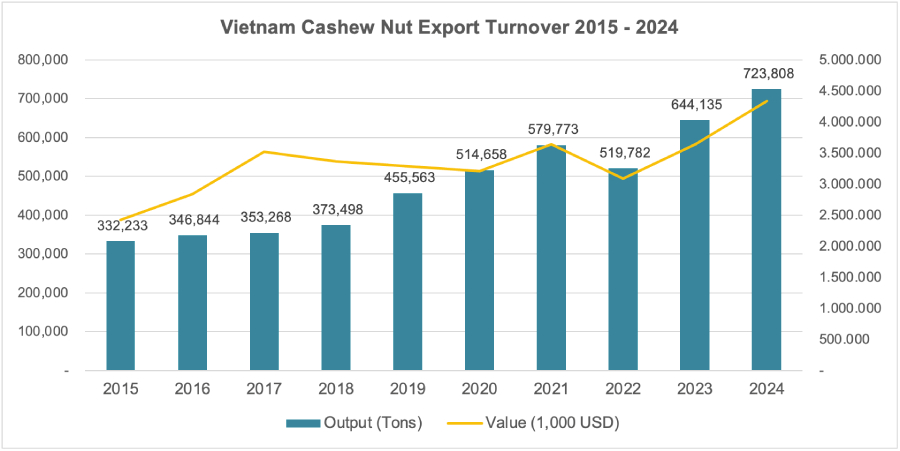
Vietnam’s rise to become the world’s leading cashew nut exporter is the result of a strategic transformation spanning more than two decades. In the early 1990s, Vietnam primarily exported raw cashew nuts. However, a pivotal shift occurred in 1996–1997 when the country made a bold decision to halt raw exports in order to preserve inputs for domestic processing.

Supported by favorable government policies, this shift triggered a rapid expansion in processing capacity—from just 40 facilities in 2000 to 200 by 2005. As a result, Vietnam surpassed India to become the world’s top cashew exporter in 2006, marking the success of a strategy centered on deep processing and value addition.

Since then, Vietnam has solidified its role as the global hub for cashew processing. Between 2015 and 2025, the country has consistently held 63–70% of the global market share for processed cashew exports, generating annual revenues of over $3 billion USD. To sustain this capacity, Vietnam has also become the world’s largest importer of raw cashew nuts, sourcing over 2 million tons per year, primarily from the Ivory Coast, Cambodia, and West African countries.

…..

3. Export Product Structure of Vietnam’s Cashew Industry: From Raw Kernels to Value-Added Products

Vietnam’s cashew exports remain heavily centered on raw shelled kernels, which account for the bulk of industry revenue. The country is currently the global leader in this segment (HS code 080132), representing over 63% of total world exports. These kernels are classified in detail according to AFI (Association of Food Industries) international standards, based on characteristics such as shape, size, and color to match the specific requirements of various global markets.

Key product classifications include: Whole kernels (W), Splits (S), Butts (B), Other broken pieces. Among these, whole white kernels W180, W240, and W320 dominate Vietnam’s export portfolio, comprising approximately 63.5% of total export volume and 70% of total turnover.

Notably, 2024 and early 2025 have marked a clear shift toward premium-grade products. Exports of W240 rose by 36%, while the highest-grade W180—often referred to as the “King” of cashew varieties—surged by 92.8% in volume. This trend reflects rising global demand from high-end retail chains, luxury hospitality, and health-focused consumers, especially in developed economies, who are willing to pay a premium for top-quality nuts.

As the price differential between premium grades (e.g., W180) and standard grades (e.g., W320) continues to grow, Vietnamese processors are actively shifting their production strategy. The focus is increasingly on value over volume, aiming to capture higher margins and strengthen Vietnam’s competitive position in the international market. This strategic pivot toward high-value segments marks an important evolution in the industry’s export model.

TABLE OF CONTENTS

Part I: Global Processed Cashew Nuts Market Outlook: Trends, Forecasts, and Key Growth Drivers

Growth Drivers: Health, Nutrition, and Product Innovation

Import Market Analysis by Region

Global Competitive Landscape: Dominance of Large Corporations

Vietnam: Global Leadership and Exceptional Growth.

Part II: Detailed Exploration of Key Consumption Markets (2025–2026)

1. The U.S. Cashew Nut Market: Trends, Consumption, and Distribution Dynamics

1.1 Consumption Trends and Key Market Drivers

1.2 Diverse Distribution Channels in the U.S. Cashew Market

1.3 Size and Growth Forecasts Overview

1.4 Demographic and Geographical Analysis of Consumption

2. Cashew Nut Market Analysis in Canada: Consumption Trends and Distribution System

2.1 Consumption Trends and Market Characteristics

2.2 Distribution and Competitive Landscape

2.3 Canadian Cashew Market Demographic Analysis

3. Cashew Nuts Market Analysis in Europe

3.1 Cashew Nut Market Overview in Germany: Size, Trends, and Consumer Analysis

3.2 Cashew Market Overview in the Netherlands: Trade Hub and Consumer Trends

3.3 Belgian Cashew Nut Market: Leading Global Consumption and Consumer Trends

3.4 UK Cashew Nut Market: Steady Growth and Sophisticated Consumption Trends

4. Asian Consumer Market: Health-Driven Demand and On-the-Go Lifestyles

4.1 China Cashew Nut Market: Massive Scale, Rapid Growth, and Emerging Trends

4.2 Middle East Cashew Market: UAE and Saudi Arabia Analysis

4.3 ASEAN Cashew Nut Market Overview: Vietnam’s Leading Role

4.4 India – A Dual Powerhouse in Cashew Production and Consumption

Part III: Decoding the Billion-Dollar Markets for Processed Cashew Imports

1. EU Cashew Nut Market: Strong Growth and Shifting Supply Dynamics

1.1 Germany’s Cashew Market: Steady Long-Term Growth, Periodic Volatility

1.2 The Netherlands Cashew Import Market: Europe’s Leading Re-Export Hub

1.3 UK Cashew Market: Steady Growth and Strong Domestic Demand

1.4 French Cashew Nut Market: Healthy Consumption Trends and a Shifting Supply Landscape

1.5 Spanish Cashew Nut Market: Rapid Expansion and Strategic Role in Europe

1.6 Italian Cashew Market: Explosive Growth and Supply Chain Restructuring

1.7 Turkish Cashew Nut Market: Rapid Growth and Policy Impact

2. US Cashew Market: Resilient Growth and Strategic Cost Leadership

3. Canadian Cashew Market: Steady Growth and Evolving Supply Structure

4. Overview of Cashew Nut Imports in Asia

4.1 China Cashew Nut Market (2014–2025): From Emerging Market to Global Contender

4.2 Japanese Cashew Nut Market: Power Shift in a Mature, High-Potential Market

4.3 UAE: The World’s Complex and Dynamic Cashew Trade Hub

5. Australia’s Cashew Nut Market: A Stable and Vietnam-Centric Landscape

Part IV: Analyzing the Competitiveness of Vietnam’s Cashew Industry: From Rapid Rise to New Challenges

1. Vietnam’s Cashew Industry: From Raw Exporter to Global Processing Powerhouse

2. Analysis of Vietnam Cashew Nut Export Turnover (2015-2025): Growth Cycles and Challenges

2.1 The Foundation of Dependency: Vietnam’s Cashew Industry Before 2015

2.3 The Boom and Adjustment Cycle of Vietnam’s Cashew Industry (2016–2018)

2.3 2019–2023: Volume-Driven Growth and a Test of Resilience

2.4 2023-2024 and Outlook for 2025

2.5 Group of leading countries importing Vietnamese cashew nuts in the period 2023 – 2024

2.6 Analysis of the Seasonal Cycle and Export Performance of the Vietnamese Cashew Industry

3. Export Product Structure of Vietnam’s Cashew Industry: From Raw Kernels to Value-Added Products

3.1 W180 Cashew Nuts: The Quality Symbol of Vietnam’s Cashew Industry

3.2 W240 Cashew Nuts: The Flagship Premium Product of Vietnam’s Cashew Industry

3.3 W320 Cashew Nuts: The “Backbone” of Vietnam’s Cashew Export Industry

4. Detailed Analysis of Vietnam’s Cashew Nut Exports to the United States (2015–2024)

4.1 2015–2017: Vietnam’s Strategic Rise in the World’s Largest Cashew Market

4.2 2018–2022: Growth Amid Crisis and the Challenge of Inflation

4.3 2023–2025: Overcoming Challenges and Setting New Records

5. Detailed Analysis of Vietnam’s Cashew Nut Exports to China (2015–2024)

5.1 China’s Self-Sufficiency Strategy and the Emerging Challenge for Vietnam’s Cashew Industry

5.2 Vietnam’s Journey to Conquer the German Cashew Market: From Disruption to New Challenges

5.3 Exporting Vietnamese Cashews to the Netherlands: A Strategic and Sustainable Partnership

5.4 UAE: Strategic Partner for Expanding into the Middle East

5.5 Türkiye’s Cashew Nut Market: Strong Recovery and Strategic Preferences

5.6 Markets with Strong Growth in Output in the Period 2020 -2024

6. Cashew Nut Export Value By Country In The First 4 Months Of 2025

Part V: Cost Constituting Vietnam's Cashew Nut Export Price (FOB)

1. The Dependence of Vietnam’s Cashew Industry on Imported Raw Materials: Causes and Current Situation

2. Raw Cashew Supply for Vietnam: Cambodia’s Rise and Strategic Challenges

3. Factors Affecting Domestic Raw Cashew Prices

3.1 Fertiliser Cost Analysis in Cashew Farming in Vietnam

3.2 Pesticide Costs in Cashew Cultivation

3.3 Labor Costs and the Mechanization Dilemma

3.4 The Economic Challenge of Vietnamese Cashew Farmers

4. Analysing Factors Affecting Vietnam’s Imported Raw Cashew Prices

5. African Countries’ Cashew Nut Production Input Costs 2024-2025

6. Vietnam’s Cashew Processing Costs and Technological Advantage

7. Domestic Logistics Cost Analysis in Vietnam’s Cashew Industry

8. Profitability Challenges and Strategic Shifts in Vietnam’s Cashew Industry

9. Restructuring the Contract Framework: Toward a Resilient Cashew Industry

Part VI: The Impact of Intermediary Chain on Vietnam's Cashew Nut Export Price

1. Cashew Value Chain in Binh Phuoc Province

2. Multilayered Import Networks: The Case of Cambodia

3. Cashew Supply Chain from Côte d’Ivoire

3.1 Producers and Organisational Structure

3.2 Structure of the Raw Cashew Nut Purchasing System in Côte d’Ivoire

4. Cashew Supply Chain from Tanzania

5. Vietnam Cashew Processing and Enterprise System: Spotlight on Binh Phuoc and Dong Nai

5.1 Binh Phuoc – The “Cashew Capital” of Vietnam

5.2 Dong Nai – Stronghold of Vietnam’s Leading Cashew Enterprises

5.3 Vietnam’s Cashew Processing Technology: From Automation to Breakthrough Innovation

5.4 Vietnam’s Cashew Nut Import and Export Landscape

5.5 Profile of Vietnam’s Leading Cashew Exporting Enterprises

Part VII: Comparing Raw Cashew Nut Quality from Leading Sources: Cambodia, Ivory Coast, and Tanzania

Part VII: Comparing Raw Cashew Nut Quality from Leading Sources: Cambodia, Ivory Coast, and Tanzania

Part VIII: Analyzing Vietnam's Competitors in the Global Cashew Nut Market

1. Detailed Analysis of the Cashew Industry and the Cashew Nut Export Status of India

1.1 Total Supply and Demand of the Cashew Industry in India from 2015 to 2024

1.2 Domestic Cashew Production in India: Expansion Without Productivity Gains

1.3 India’s Raw Cashew Nut Supply: A Historic Shift from East to West Africa: A Turnaround and Strategic Pivot

1.4 India’s Cashew Nut Export Market: From Global Leader to Struggling Competitor

1.5 Indian Cashew Supply Chain

1.6 Government of India’s Policy to Regain Market Share in Cashew Exports

2. Ivory Coast Cashew Processing Industry

2.1 Total supply and demand of the Ivory Coast cashew industry from 2015 to 2024

2.2 Ivory Coast’s domestic cashew production

2.4 Ivory Coast Cashew Quality Analysis by Region: Differences between Bondoukou, Dabakala and Mankono

2.5 Ivory Coast’s Processed Cashew Nut Exports (2020–2025): Breakthrough Driven by Global Supply Chain Shifts

2.6 Economic Analysis of the Ivorian Cashew Processing Industry: Rising Input Costs and the Impact of Supply Leakage

2.8 Ivory Coast government policies supporting the cashew processing industry

Part IX: Global Cashew Nuts Market Competition Trends and Forecast 2025- 2026

1. Detailed Analysis: Price Manipulation Mechanisms in the Global Cashew Industry

2. Forecast of Global Raw Cashew Nut Production and Supply

2.1 Southeast Asia Production Hub: Vietnam and Cambodia Strengthen Strategic Roles

2.2 Côte d’Ivoire: Sustaining Global Leadership Amid Strategic Policy Shifts

2.3 Tanzania: Auction Reform and Drive Toward Full Localisation

2.4 Benin: Combining Export Bans with a Push for Sustainable Growth

2.5 Ghana: Recovery Driven by Weather and Regional Cooperation

2.6 Mozambique and Nigeria: Emerging Suppliers Amid Global Competition

3. Monetary Policy and Its Impact on Vietnam’s Cashew Industry

4. Competitive Trends and Market Strategies for North American Cashew Imports

5. The Impact of War on the Cashew Supply Chain

OTHER PUBLICATIONS

Explore more in-depth publications from Vietnam Commodity Exports – featuring market analysis, trade trends, and strategies for key sectors like coffee, cashew, and fruit. Updated data and bilingual content designed for exporters and global investors.